
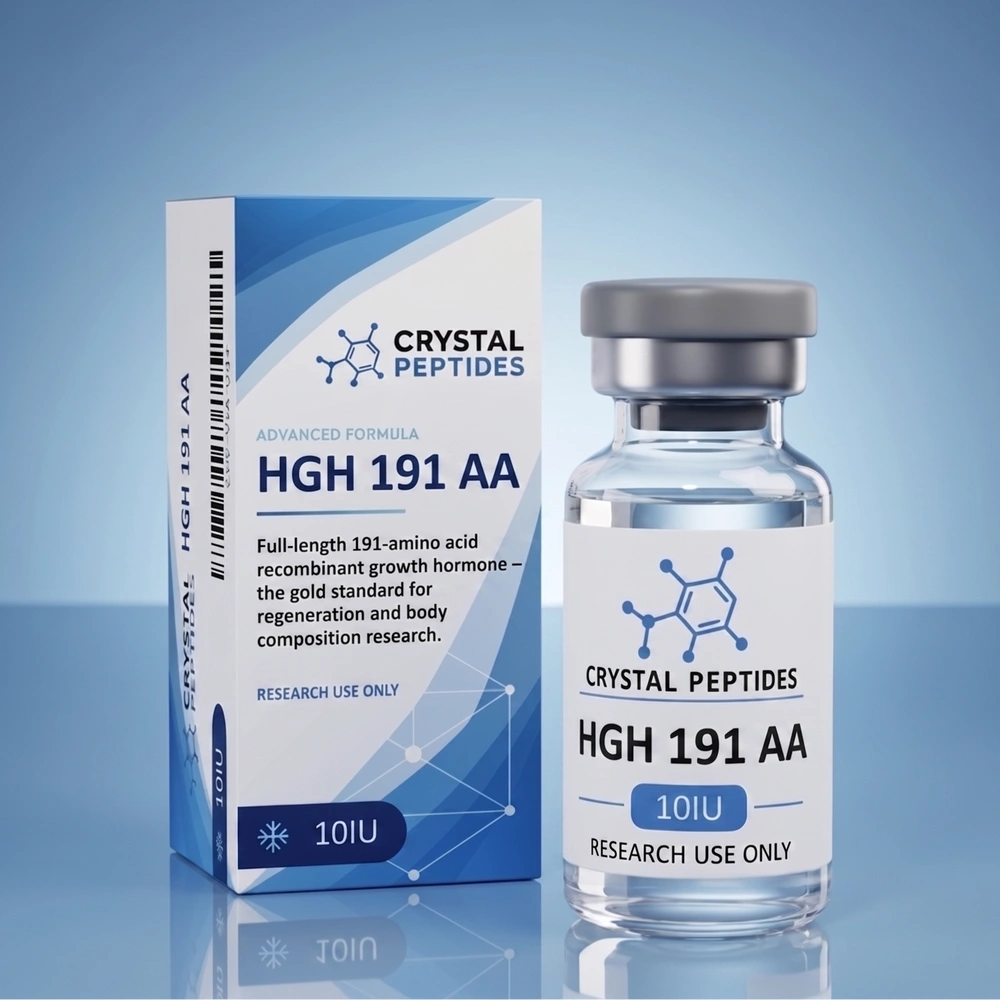
HGH (10 IU)
❄️Lyophilisiertes Pulver (nicht rekonstituiert)
Größe:
Gesamt: 21.67 CHF
Rabatt pro Menge
| Menge | Rabatt | Preis pro Einheit |
|---|---|---|
| 5 - 10 | 10% | 19.51 CHF |
| 11 - 20 | 15% | 18.42 CHF |
| 21+ | 20% | 17.34 CHF |
Strenge Tests durch unabhängige Labore
Jede Charge unserer Forschungschemikalien und Peptide wird von einem unabhängigen Labor auf Reinheit und Identität geprüft.
Gesamt: 21.67 CHF
Retatrutide ist ein synthetisches Peptid aus der Klasse der Multi-Rezeptor-Inkretin-Agonisten, das darauf ausgelegt ist, drei verwandte Rezeptoren anzusprechen: GLP-1R, GIPR und GCGR. Dabei handelt es sich um Klasse-B-G-Protein-gekoppelte Rezeptoren innerhalb des Inkretin-Signalsystems, eines Hormonnetzwerks, das die metabolische Kommunikation zwischen Bauchspeicheldrüse, Magen-Darm-Trakt, Leber und Gehirn koordiniert.
Forscher innerhalb der Europäischen Union können Retatrutide 30 mg kaufen bei Crystal Peptides. Es handelt sich um ein hochreines Forschungspeptid, das von akkreditierten Laboren unabhängig auf Peptididentität, Reinheit und analytische Konsistenz geprüft wird. Für jede Produktcharge sind Analysezertifikate erhältlich, um Forschern die vollständige Transparenz, Rückverfolgbarkeit und Qualitätsdokumentation zu bieten, die für fortgeschrittene Inkretin- und Stoffwechselforschungsverbindungen erwartet wird.
Struktur und Design von Retatrutide
Strukturell basiert Retatrutide auf einem GIP-Peptidgerüst mit gezielten Substitutionen, die eine Kreuzreaktivität an den GLP-1- und Glukagonrezeptoren einführen. Mehrere Schlüsselmodifikationen tragen zu seiner Rezeptoraktivität und seinem pharmakokinetischen Profil bei:
- Aib² (2-Aminoisobuttersäure) an Position 2 erhöht die Resistenz gegen den Abbau durch Dipeptidylpeptidase-4 (DPP-4) und trägt so zur verlängerten biologischen Aktivität des Peptids bei.
- αMeLeu¹³ (α-Methylleucin) an Position 13 verstärkt die Aktivität sowohl am GIP- als auch am Glukagonrezeptor und trägt dazu bei, einen ausgewogenen Multi-Rezeptor-Agonismus aufrechtzuerhalten.
- Aib²⁰ (2-Aminoisobuttersäure) an Position 20 trägt zu den pharmakokinetischen Eigenschaften des Peptids bei und unterstützt seine Aktivität am GIP-Rezeptor.
- C-terminale Amidierung verringert die Anfälligkeit für den Abbau durch Carboxypeptidasen und verbessert die Gesamtstabilität des Peptids.
Das Molekül trägt eine C20-Fettdisäure, die über einen Gamma-Glutamat- und AEEA-Linker an einer Lysin-Seitenkette konjugiert ist. Dies ermöglicht eine reversible Albuminbindung, die die lange Zirkulationshalbwertszeit von etwa sechs Tagen bewirkt und dem in seinem gesamten klinischen Programm verwendeten wöchentlichen Dosierungsschema zugrunde liegt.
Der dritte Rezeptor ist es, der Retatrutide von tirzepatide unterscheidet. Duale Agonisten wirken auf GIP und GLP-1. Die zusätzliche Aktivität am Glukagonrezeptor bringt einen Signalweg ins Spiel, der mit Energieverbrauch und hepatischer Fettoxidation assoziiert ist, und bietet Forschern damit ein Werkzeug zur Untersuchung der metabolischen Regulation über mehrere Signalwege hinweg, statt sich allein auf Appetit- und Glykämie-Signalisierung zu beschränken.
Chemische Eigenschaften und Registrierungsinformationen
Eigenschaft | Wert |
Name und Synonyme | Retatrutide, LY3437943, LY-3437943, GLP-3, Triple-G, GGG-Triagonist |
PubChem-CID | 171390338 |
CAS-Nummer | 2381089-83-2 |
FDA-UNII | NOP2Y096GV |
Summenformel | C221H342N46O68 |
Molekulargewicht | 4731,4 g/mol |
Peptidlänge | 39 Aminosäuren |
Verbindungsklasse | Synthetischer Triple-Inkretin-Rezeptor-Agonist |
Primäre Zielstrukturen | GLP-1R, GIPR, GCGR |
Rezeptorpotenz (humaner EC50) | GIPR 0,0643 nM; GLP-1R 0,775 nM; GCGR 5,79 nM |
Halbwertszeit | Etwa 6 Tage |
Physikalische Form | Weißes bis cremefarbenes lyophilisiertes Pulver |
Löslichkeit | Bakteriostatisches oder steriles Wasser; DMSO; PBS pH 7,2 |
Entwickler | Eli Lilly and Company |
Reinheit | Siehe COA |
Fläschchengrößen |
|
Klinische Daten und Forschungshintergrund
Retatrutide ist eines der neuesten experimentellen Peptide im Bereich der Inkretine und hat aufgrund seines einzigartigen Triple-Rezeptor-Wirkmechanismus erhebliches wissenschaftliches Interesse geweckt. Seit seiner Entwicklung haben veröffentlichte präklinische und klinische Studien seine Pharmakologie, Rezeptorbiologie, Pharmakokinetik und physiologischen Effekte untersucht, wodurch Retatrutide zu einem zunehmend wichtigen Forschungswerkzeug für die Untersuchung metabolischer und endokriner Signalwege wird.
Forscher, die Retatrutide kaufen möchten, sollten beachten, dass die nachfolgend zusammengefassten Studien ausschließlich der Beschreibung der aktuellen wissenschaftlichen Literatur dienen und nicht als Nachweis der klinischen Wirksamkeit oder einer zugelassenen therapeutischen Verwendung des von Crystal Peptides gelieferten Forschungsmaterials ausgelegt werden sollten.
Phase-2-Proof-of-Concept-Studie (Jastreboff et al., 2023)
Eine der bahnbrechenden Veröffentlichungen in der Retatrutide-Forschung war die randomisierte, doppelblinde, placebokontrollierte Phase-2-Studie, die 2023 im New England Journal of Medicine veröffentlicht wurde. Die Studie lieferte die erste umfassende klinische Charakterisierung von Retatrutide über mehrere Dosisstufen hinweg über einen Behandlungszeitraum von 48 Wochen und lieferte wertvolle Informationen zu Pharmakokinetik, Sicherheitsprofil und biologischer Aktivität. Bei der höchsten untersuchten Dosis berichteten die Prüfärzte von einer mittleren Körpergewichtsreduktion von 24,2 %, was die weitere Untersuchung des Triple-Rezeptor-Agonismus in größer angelegten klinischen Programmen unterstützt.
Das Phase-3-Programm TRIUMPH
Aufbauend auf diesen Erkenntnissen wurde Retatrutide in das internationale Phase-3-Programm TRIUMPH aufgenommen. Zu den ersten Studien, die Ergebnisse vorlegten, gehörte TRIUMPH-4, eine 68-wöchige randomisierte, doppelblinde, placebokontrollierte Studie mit Teilnehmern mit Adipositas und Kniearthrose. Die Prüfärzte berichteten von mittleren Körpergewichtsreduktionen von nahezu 28 % sowie von Verbesserungen bei mehreren vordefinierten Studienendpunkten, was das wissenschaftliche Verständnis der biologischen Aktivität von Retatrutide weiter erweiterte. Erste Ergebnisse der zentralen TRIUMPH-1-Studie mit 2.339 Teilnehmern zeigten anschließend dosisabhängige biologische Reaktionen über 80 Wochen, mit einer längerfristigen Nachbeobachtung bis zu 104 Wochen. Diese Untersuchungen prägen weiterhin die sich entwickelnde wissenschaftliche Literatur zu Triple-Rezeptor-Inkretin-Agonisten.
Retatrutide im Vergleich zu Tirzepatid und anderen Inkretin-Agonisten
Mit der Ausweitung der klinischen und mechanistischen Forschung wurde Retatrutide häufig mit anderen Inkretin-basierten Verbindungen verglichen, insbesondere mit Tirzepatide und Semaglutide. Anders als Tirzepatide, das die GLP-1- und GIP-Rezeptoren aktiviert, aktiviert Retatrutide zusätzlich den Glukagonrezeptor und ist damit der erste Triple-Rezeptor-Agonist, der in fortgeschrittene klinische Phase-3-Forschung vorgedrungen ist. Forscher vergleichen Retatrutide zudem mit Semaglutide, einem selektiven GLP-1-Rezeptor-Agonisten, um besser zu verstehen, wie sich die Multi-Rezeptor-Aktivierung von der selektiven GLP-1-Rezeptor-Signalisierung unterscheidet. Diese Vergleiche fließen weiterhin in die Forschung zur Inkretinbiologie und den physiologischen Folgen der gleichzeitigen Aktivierung mehrerer endokriner Signalwege ein.
Aktueller wissenschaftlicher Kenntnisstand
Die verfügbaren Daten haben Retatrutide als einen der umfassendsten untersuchten experimentellen Triple-Rezeptor-Agonisten in der aktuellen Entwicklung etabliert. Zusammen haben das Phase-2-Programm, die laufenden TRIUMPH-Studien und ein wachsender Bestand an mechanistischer Forschung das wissenschaftliche Verständnis der gleichzeitigen GLP-1-, GIP- und Glukagonrezeptor-Aktivierung deutlich erweitert.
Retatrutide befindet sich im experimentellen Stadium und ist Stand 2026 weder von der FDA noch von der EMA oder einer anderen wichtigen Zulassungsbehörde zugelassen. |
Forschungsanwendungen
Retatrutide wird als molekulares Werkzeug zur Untersuchung der Inkretin-Signalgebung und der durch nährstoffempfindliche Hormone gesteuerten Stoffwechselwege eingesetzt. Da es drei Rezeptorsysteme gleichzeitig aktiviert, ermöglicht es Forschern zu untersuchen, wie sich koordinierte Signalgebung über GLP-1-, GIP- und Glukagon-Signalwege auf intrazelluläre Netzwerke und die gewebeübergreifende metabolische Kommunikation auswirkt.
Energieverbrauch und Thermogenese
Der Glukagonrezeptor-Zweig ist das unterscheidende Forschungsziel. Die Aktivierung des Glukagonrezeptors wird mit einem erhöhten Energieverbrauch und einer verstärkten Substratmobilisierung in Verbindung gebracht. Experimentelle Arbeiten untersuchen, wie das Hinzufügen dieses dritten Signalwegs zu einem dualen Inkretin-Agonismus die basale Stoffwechselrate, die Lipolyse und die thermogene Signalgebung in zellulären und präklinischen Modellen verändert.
Leberfett und Leberstoffwechsel
Die Aktivierung des Glukagonrezeptors fördert die hepatische Fettoxidation. Studien untersuchen die Genexpression, die Aktivität metabolischer Enzyme und die Lipidverarbeitungswege in hepatischen Zellsystemen und Tiermodellen, wodurch Retatrutide zu einem häufig eingesetzten Werkzeug in Forschungsmodellen der metabolisch assoziierten steatotischen Lebererkrankung und der Steatohepatitis wird.
Glukose-Signalgebung und endokrine Signalwege
In isolierten Inselzellen und endokrinen Zellmodellen nutzen Forscher Retatrutide, um die Second-Messenger-Signalgebung, die Kinaseaktivierung und die transkriptionellen Reaktionen in insulinproduzierenden Betazellen zu untersuchen. Die Triple-Rezeptor-Beteiligung liefert ein Modell zur Untersuchung, wie eine gleichzeitige Stimulation die glukoseabhängige endokrine Signalgebung beeinflusst.
Lipidstoffwechsel und Biologie des Fettgewebes
Adipozytenkulturen und Tiermodelle werden eingesetzt, um zu analysieren, wie die Triple-Rezeptor-Aktivierung die Enzymaktivität bei der Fettsäureverarbeitung und die transkriptionelle Regulation lipidrelevanter Gene beeinflusst.
Vergleichende Rezeptorpharmakologie
Die gemessenen Potenzen von Retatrutide unterscheiden sich deutlich zwischen seinen drei Zielstrukturen: 0,0643 nM am GIPR, 0,775 nM am GLP-1R und 5,79 nM am GCGR. Diese rund zwölffach höhere GIPR-Selektivität gegenüber GLP-1R, kombiniert mit einer deutlich geringeren Glukagonrezeptor-Potenz, macht es zu einem nützlichen Untersuchungsgegenstand für Signalverzerrung (Bias) und Rezeptor-Crosstalk. Vergleichsstudien mit Tirzepatid und Semaglutid isolieren den Beitrag jedes einzelnen Rezeptors.
Wie Retatrutide wirkt (Wirkmechanismus)
Retatrutide fungiert als Triple-Agonist der GLP-1-, GIP- und Glukagonrezeptoren, allesamt Klasse-B-G-Protein-gekoppelte Rezeptoren, die an der metabolischen Signalgebung und der nährstoffabhängigen Hormonregulation beteiligt sind.
Zielbindung
Das Peptidgerüst leitet sich vom nativen GIP ab, mit Substitutionen, die die Rezeptoraffinität und -stabilität verändern. Diese Modifikationen ermöglichen es Retatrutide, den GIPR mit hoher Potenz zu binden, während die Agonistenaktivität am GLP-1R und GCGR erhalten bleibt. Bei der Bindung induziert das Peptid Konformationsänderungen, die intrazelluläre G-Protein-Signalwege aktivieren, die typisch für Klasse-B-GPCRs sind. Die C20-Fettdisäure-Konjugation ermöglicht eine reversible Albuminbindung und verlängert die Persistenz in experimentellen Systemen.
Nachgeschaltete Signalwege
Die Rezeptoraktivierung stimuliert den Gs-Protein-Signalweg, aktiviert die Adenylatzyklase und erhöht das intrazelluläre zyklische AMP. Erhöhtes cAMP aktiviert die Proteinkinase A und verwandte Signalmoleküle, was Phosphorylierungsereignisse und transkriptionelle Reaktionen in den betroffenen Zellen auslöst. Da alle drei Rezeptoren auf überlappende Second-Messenger-Systeme konvergieren, sich aber auf unterschiedliche Gewebearten verteilen, ermöglicht Retatrutide Forschern zu untersuchen, wie konvergente Signalgebung von unterschiedlichen Rezeptoren innerhalb eines einzelnen Zelltyps integriert wird.
Zelluläre Effekte in experimentellen Modellen
In Zellkultur- und Tiermodellen wurde berichtet, dass Retatrutide die intrazellulären zyklischen AMP-Spiegel moduliert, die mit Stoffwechsel-Signalwegen assoziierte Genexpression verändert und die metabolische Aktivität in betroffenen Geweben beeinflusst. Die Glukagonrezeptor-Komponente trägt zu Effekten auf die hepatische Glukoseabgabe und die Lipidoxidation bei, die bei dualen Agonisten nicht beobachtet werden.
Retatrutide im Vergleich zu verwandten Forschungsverbindungen
Retatrutide steht an der Spitze einer abgestuften Reihe von Inkretin-Verbindungen, die sich durch die Anzahl der angesprochenen Rezeptoren unterscheiden.
Eigenschaft | |||
Typ | Synthetisches Triple-Agonist-Peptid | Synthetisches Dual-Agonist-Peptid | Synthetisches GLP-1-Peptidanalogon |
Primäre Zielstrukturen | GLP-1R, GIPR, GCGR | GIPR, GLP-1R | GLP-1R |
Klasse | Triple-Agonist | Dual-Agonist | Einzel-Agonist |
Unterscheidender Signalweg | Glukagonrezeptor: Energieverbrauch, hepatische Fettoxidation | GIP-Rezeptor zusätzlich zu GLP-1 | Basaler Inkretin-Signalweg |
Höchster berichteter Gewichtsverlust in Studien | Bis zu 24,2 % (Ph. 2), bis zu 30,3 % (Ph. 3, schwere Adipositas) | Etwa 21 % | Etwa 15 % |
Entwickler | Eli Lilly | Eli Lilly | Novo Nordisk |
Klinisches Stadium | Experimentell, Phase 3 | Als Arzneimittel zugelassen | Als Arzneimittel zugelassen |
Hier geliefert als | Verbindung zu Forschungszwecken | Verbindung zu Forschungszwecken | Verbindung zu Forschungszwecken |
Die Gewichtsverlustzahlen stammen aus separaten klinischen Studien und sind keine direkten Vergleiche. Der Zulassungsstatus bezieht sich auf die zugelassenen Arzneimittel. Alle Verbindungen werden von Crystal Peptides ausschließlich als Forschungsreagenzien geliefert.
Semaglutid liefert die Basislinie mit einem einzelnen Rezeptor. Tirzepatid isoliert den Effekt der zusätzlichen GIP-Aktivität. Retatrutide fügt Glukagon hinzu, worauf die berichteten Zugewinne beim Energieverbrauch und bei der hepatischen Fettclearance zurückzuführen sind.
Qualität und Testung
Jede Charge wird per HPLC getestet und unabhängig durch die analytische Testung von Janoshik verifiziert, mit einem chargenspezifischen Analysezertifikat. Gefälschte und generische Sammel-COAs sind auf diesem Markt weit verbreitet. Die chargenspezifische Verifizierung durch ein namentlich genanntes Labor ist die einzig verlässliche Kontrolle.
Regulatorisches und Rechtliches
Alle von Crystal Peptides gelieferten Produkte sind ausschließlich für Forschungs- und Entwicklungszwecke bestimmt. Diese Materialien sind für Laboruntersuchungen bestimmt und nicht zur Anwendung am Menschen oder am Tier vorgesehen.
Dieses Produkt ist kein Arzneimittel, Lebensmittel, Nahrungsergänzungsmittel, Medizinprodukt oder Kosmetikum. Retatrutide ist von der Europäischen Arzneimittel-Agentur, der US-amerikanischen Food and Drug Administration oder einer anderen nationalen Zulassungsbehörde nicht als Arzneimittel zugelassen. Alle Aussagen zu dieser Verbindung stammen aus veröffentlichter wissenschaftlicher Forschung und wurden von keiner Zulassungsbehörde bewertet. Diese Materialien sind nicht dazu bestimmt, Krankheiten zu diagnostizieren, zu behandeln, zu heilen oder vorzubeugen.
Materialien dürfen nur von qualifizierten Fachkräften gehandhabt werden, die in Laborforschungsverfahren geschult sind. Die Einbringung dieses Produkts in Menschen oder Tiere ist untersagt und kann gegen geltende Gesetze und Vorschriften verstoßen. Käufer sind dafür verantwortlich, sicherzustellen, dass Verwendung, Lagerung, Handhabung und Entsorgung den geltenden nationalen und lokalen Vorschriften entsprechen. Die Vorschriften zu Kauf und Import von Forschungschemikalien unterscheiden sich von Land zu Land.
LABORREAGENZ, NUR FÜR FORSCHUNGSZWECKE. Kein Arzneimittel und kein Lebensmittel. Nicht für den menschlichen Verzehr bestimmt.
Quellen und Referenzen
- Jastreboff AM, et al. Triple-Hormone-Receptor Agonist Retatrutide for Obesity: A Phase 2 Trial. New England Journal of Medicine. 2023. PMID: 37366315
- Rosenstock J, et al. Retatrutide, a GIP, GLP-1 and glucagon receptor agonist, for people with type 2 diabetes: a randomised, double-blind, placebo-controlled, phase 2 trial. The Lancet. 2023.
- TRIUMPH-Studienprogramm: Begründung und Design. PMID: 41090431
- Katsi V, Koutsopoulos G, Fragoulis C, Dimitriadis K, Tsioufis K. Retatrutide: A Game Changer in Obesity Pharmacotherapy. Biomolecules. 2025. doi:10.3390/biom15060796
- Marathe SJ, et al. Incretin triple agonist retatrutide (LY3437943) alleviates obesity-associated cancer progression. npj Metabolic Health and Disease. 2025;3(1).
- Ma J, et al. Comparison of the effects of Liraglutide, Tirzepatide, and Retatrutide on diabetic kidney disease in db/db mice. Endocrine. 2024. doi:10.1007/s12020-024-03998-8
- PubChem Compound Summary for CID 171390338, Retatrutide. National Center for Biotechnology Information.
TAB 4: FAQ
Was ist Retatrutide?
Retatrutide (LY3437943), auch bekannt als GLP-3 oder Triple-G, ist ein synthetisches First-in-Class-Peptid, das gleichzeitig die GLP-1-, GIP- und Glukagonrezeptoren aktiviert. Dieser einzigartige Triple-Rezeptor-Mechanismus hat Retatrutide zu einem der am umfassendsten untersuchten experimentellen Inkretin-Peptide in der Stoffwechselforschung gemacht. Crystal Peptides liefert Retatrutide ausschließlich für die Labor-Forschung und -Entwicklung und nicht für die Anwendung am Menschen oder am Tier.
Warum wird Retatrutide GLP-3 oder Triple-G genannt?
Die Bezeichnungen GLP-3 und Triple-G sind Begriffe aus dem Forschungsmarkt, die die Aktivität von Retatrutide an drei Hormonrezeptoren widerspiegeln, statt der beiden, auf die Tirzepatid abzielt. Sie beziehen sich auf dieselbe experimentelle Verbindung, LY3437943, entwickelt von Eli Lilly. PubChem erkennt Triple-G ebenfalls als Synonym für Retatrutide an.
Wo kann ich Retatrutide online kaufen?
Forscher innerhalb Europas können Retatrutide online bei Crystal Peptides in lyophilisierten Fläschchen zu 10 mg, 20 mg und 30 mg kaufen. Jede Charge wird unabhängig durch Dritte analytisch getestet und mit einem chargenspezifischen Analysezertifikat (COA) geliefert, das die für die Laborforschung erwartete Transparenz, Rückverfolgbarkeit und Qualitätsdokumentation bietet.
In welchen Fläschchengrößen ist Retatrutide erhältlich?
Crystal Peptides liefert Retatrutide in lyophilisierten Fläschchen zu 10 mg, 20 mg und 30 mg, um unterschiedlichen Forschungsanforderungen gerecht zu werden. Im breiteren Forschungsmarkt ist Retatrutide in verschiedenen Stärken erhältlich, wobei sich Konzentration und Produktqualität zwischen Anbietern unterscheiden können. Forscher sollten die gelieferte Menge stets anhand des beiliegenden chargenspezifischen Analysezertifikats überprüfen.
Was unterscheidet Retatrutide von Tirzepatid?
Obwohl beide Peptide zur Klasse der Inkretine gehören, unterscheiden sie sich in ihrer Rezeptorselektivität. Tirzepatid ist ein Dual-Agonist, der die GLP-1- und GIP-Rezeptoren aktiviert, während Retatrutide ein Triple-Agonist ist, der zusätzlich den Glukagonrezeptor (GCGR) aktiviert. Diese zusätzliche Rezeptoraktivität hat Retatrutide zu einem wichtigen Forschungswerkzeug gemacht, um die biologischen Effekte der gleichzeitigen Aktivierung von GLP-1-, GIP- und Glukagonrezeptoren zu untersuchen und den Triple-Agonismus mit der dualen Inkretin-Signalgebung zu vergleichen.
Wie schneidet Retatrutide im Vergleich zu Semaglutid ab?
Semaglutid ist ein selektiver GLP-1-Rezeptor-Agonist, während Retatrutide gleichzeitig die GLP-1-, GIP- und Glukagonrezeptoren aktiviert. Forscher vergleichen diese Peptide häufig, um Unterschiede zwischen der selektiven GLP-1-Rezeptor-Aktivierung und der Multi-Rezeptor-Inkretin-Signalgebung zu untersuchen. Semaglutid bleibt eine wichtige Referenzverbindung für die GLP-1-Rezeptor-Biologie, während Retatrutide die Forschung zum Triple-Rezeptor-Agonismus und zur integrierten endokrinen Signalgebung erweitert hat.
Was haben veröffentlichte klinische Studien zu Retatrutide berichtet?
Veröffentlichte klinische Studien der Phasen 2 und 3 haben Retatrutide als einen der am umfassendsten untersuchten experimentellen Triple-Rezeptor-Agonisten etabliert. Die im New England Journal of Medicine veröffentlichte Phase-2-Studie berichtete von mittleren Körpergewichtsreduktionen von bis zu 24,2 % nach 48 Wochen, während erste Ergebnisse des Phase-3-Programms TRIUMPH-1 von mittleren Reduktionen von bis zu 25,0 % nach 80 Wochen berichteten, wobei längerfristige Erweiterungsdaten bei Teilnehmern mit schwerer Adipositas 30,3 % erreichten. Diese Ergebnisse dienen ausschließlich der Zusammenfassung der veröffentlichten wissenschaftlichen Literatur und sollten nicht als Nachweis einer zugelassenen therapeutischen Anwendung oder als Vorhersage individueller Ergebnisse ausgelegt werden.
Ist Retatrutide legal, und ist ein Rezept erforderlich?
Retatrutide bleibt eine experimentelle Verbindung und wurde in den wichtigsten Rechtsordnungen nicht als Arzneimittel zugelassen. Crystal Peptides liefert Retatrutide ausschließlich als Forschungsreagenz für die Labor-Forschung und -Entwicklung und nicht als Arzneimittel. Da es nicht als Arzneimittel geliefert wird, gelten Rezeptpflichten nicht in derselben Weise wie für zugelassene Arzneimittel. Forscher sind dafür verantwortlich sicherzustellen, dass Kauf, Einfuhr, Besitz und Verwendung von Forschungsverbindungen den in ihrem jeweiligen Land geltenden Gesetzen und Vorschriften entsprechen.
Ist Retatrutide im Sport verboten?
Ja. Retatrutide fällt unter die von der Welt-Anti-Doping-Agentur (WADA) verbotenen Substanzkategorien. Als experimenteller Stoffwechselmodulator sollte es nicht von Athleten verwendet werden, die den Anti-Doping-Bestimmungen unterliegen.
Wie sollte Retatrutide rekonstituiert und gelagert werden?
Retatrutide wird als lyophilisiertes Peptid geliefert und wird üblicherweise mit sterilem oder bakteriostatischem Wasser rekonstituiert, das langsam an der Innenwand des Fläschchens entlang zugegeben wird. Die Lösung sollte sich auf natürliche Weise auflösen, ohne kräftiges Schütteln oder Vortexen. Lyophilisierte Fläschchen sollten bei -20 °C oder darunter gelagert werden, geschützt vor Licht und Feuchtigkeit. Nach der Rekonstitution sollten Lösungen im Allgemeinen bei 2-8 °C gekühlt werden, wobei wiederholte Gefrier-Tau-Zyklen zu minimieren sind, um die Stabilität des Peptids zu erhalten.
Wird Retatrutide von Crystal Peptides von Dritten getestet?
Ja. Jede Charge von Retatrutide, die von Crystal Peptides geliefert wird, wird unabhängig durch Dritte analytisch getestet und mit einem chargenspezifischen Analysezertifikat versehen. Die Tests umfassen analytische Verfahren wie HPLC zur Überprüfung von Reinheit und Qualität, sodass Forscher Identität, Reinheit und analytische Konsistenz der genauen gelieferten Charge unabhängig überprüfen können.
Versenden Sie Retatrutide innerhalb Europas?
Ja. Crystal Peptides versendet Retatrutide europaweit mit diskreter Verpackung und nachverfolgbaren Versanddiensten. Informationen zu Versandzielen, geschätzten Lieferzeiten und verfügbaren Versandoptionen finden Sie auf der Seite Versandinformationen.