❄️Lyophilized powder
Größe:
Rabatt pro Menge
| Menge | Rabatt | Preis pro Einheit |
|---|---|---|
| 5 - 10 | 10% | €40.49 |
| 11 - 20 | 15% | €38.24 |
| 21+ | 20% | €35.99 |
Strenge Tests durch unabhängige Labore
Jede Charge unserer Forschungschemikalien und Peptide wird von einem unabhängigen Labor auf Reinheit und Identität geprüft.
Gesamt: €44.99
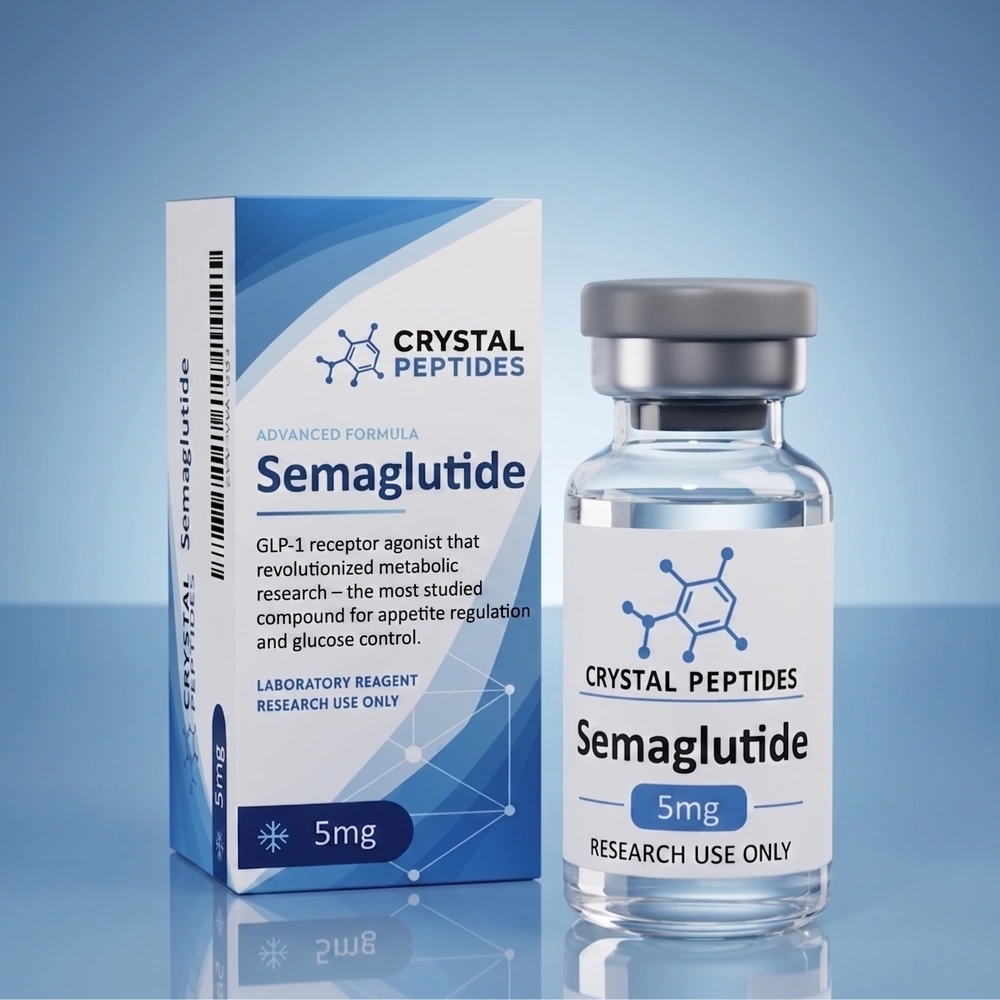
Semaglutide is a long-acting glucagon-like peptide-1 (GLP-1) receptor agonist comprising a modified 31-amino-acid peptide engineered for prolonged biological activity. It features structural modifications, including amino acid substitutions and the attachment of a fatty diacid side chain that promotes reversible albumin binding, which substantially extend its circulating half-life compared with native GLP-1.
These properties have made semaglutide one of the most extensively investigated peptides in metabolic and endocrine research, particularly in studies of GLP-1 receptor pharmacology, incretin biology, appetite signalling, gastric physiology, and glucose homeostasis.
Researchers within the European Union can buy semaglutide 5mg from Crystal Peptides as a high-purity research peptide independently tested by accredited laboratories for peptide identity, purity, and analytical consistency. Every batch is accompanied by a Certificate of Analysis that can be traced directly to the independent testing laboratory, providing researchers with the transparency, traceability, and quality documentation expected for high-quality semaglutide research.
Semaglutide has become a valuable research tool because it combines highly selective GLP-1 receptor activation with a pharmacokinetic profile suitable for investigating sustained incretin signalling. Unlike native GLP-1, which is rapidly degraded by dipeptidyl peptidase-4 (DPP-4), semaglutide remains in circulation for significantly longer through albumin binding and improved enzymatic stability.
This has enabled researchers to investigate long-term GLP-1 receptor activation, endocrine regulation, receptor pharmacology, and metabolic physiology using a well-characterised experimental model supported by an extensive body of published scientific literature.
Disclaimer: Although semaglutide is the active ingredient used in certain authorised medicinal products, the semaglutide peptide supplied by Crystal Peptides is provided exclusively as a laboratory research peptide. It is not a medicinal product and is not intended for human or veterinary use. Any discussion of semaglutide biology or published clinical research is included solely to explain the pharmacology and scientific background of the peptide and should not be interpreted as evidence of clinical efficacy or authorised therapeutic use of this research material. |
|---|
Specification | Details |
|---|---|
Product name | Semaglutide 5 mg |
Alternative names | Semaglutide, GLP-1 analogue |
Peptide class | Long-acting glucagon-like peptide-1 (GLP-1) receptor agonist |
Peptide length | 31 amino acids |
Structural modifications | Two amino acid substitutions and a C18 fatty diacid side chain attached via a spacer to promote albumin binding and prolonged biological activity |
Molecular formula | C187H291N45O59 |
Molecular weight | 4113.58 g/mol |
PubChem CID | 56843331 |
CAS number | 910463-68-2 |
Appearance | White to off-white lyophilised powder |
Purity | ≥99% (HPLC; confirm with COA) |
Solubility | Soluble in sterile water or bacteriostatic water following laboratory reconstitution |
Storage | Store lyophilised material at -20°C or below, protected from light and moisture. Following reconstitution, refrigerate at 2–8°C and avoid repeated freeze-thaw cycles. |
Research category | GLP-1 receptor pharmacology, incretin biology, and metabolic research |
Intended use | For laboratory research only. Not for human or veterinary use. |
Semaglutide features structural modifications reduce susceptibility to degradation by dipeptidyl peptidase-4 (DPP-4) and promote reversible albumin binding, enabling prolonged receptor activation and making it ideal for investigating incretin biology, endocrine regulation, and GLP-1 receptor signalling.
Semaglutide has become one of the most extensively characterised glucagon-like peptide-1 (GLP-1) receptor agonists in modern endocrine research. Since its development, it has been investigated in a large body of biochemical, physiological, and human clinical studies that have substantially advanced scientific understanding of GLP-1 receptor pharmacology, incretin biology, and metabolic regulation.
The landmark publications highlighted below are presented solely to summarise the scientific literature surrounding semaglutide and should not be interpreted as evidence of clinical efficacy or authorised therapeutic use of the research material supplied by Crystal Peptides.
The development of semaglutide represented a significant advance in GLP-1 peptide engineering. Building on earlier work with liraglutide, researchers modified the native GLP-1 sequence by introducing targeted amino acid substitutions together with the attachment of a C18 fatty diacid side chain via a hydrophilic linker. These structural modifications improved resistance to degradation by dipeptidyl peptidase-4 (DPP-4) while enabling reversible albumin binding, substantially prolonging the peptide's circulating half-life without compromising high affinity for the GLP-1 receptor. This rational design strategy established the molecular framework that continues to underpin semaglutide research today. [1]
A comprehensive 2025 review titled Semaglutide from Bench to Bedside brought together the extensive body of biochemical, physiological, and clinical research that has accumulated since the peptide's development. Rather than presenting new experimental findings, the authors synthesised the available evidence describing semaglutide's molecular engineering, GLP-1 receptor pharmacology, pharmacokinetics, and broader role in incretin biology. The review also discusses the peptide's place within the rapidly evolving field of metabolic research and compares semaglutide with newer incretin-based compounds, making it one of the most comprehensive contemporary references for researchers seeking an overview of the current scientific understanding of semaglutide. This publication is included to summarise the state of the scientific literature and should not be interpreted as evidence of clinical efficacy or authorised therapeutic use of the semaglutide supplied by Crystal Peptides. [2]
The global SUSTAIN programme represents one of the largest collections of published human studies involving semaglutide. Across multiple randomised clinical investigations, researchers extensively characterised the peptide's pharmacokinetics, receptor pharmacology, physiological effects, and overall safety profile. Although these studies were conducted within clinical research settings, they also contributed substantially to the broader scientific understanding of GLP-1 receptor activation and incretin biology. The observations from these trials are included here solely because they have shaped the modern scientific literature surrounding semaglutide and should not be interpreted as evidence supporting therapeutic use of this research material. [3]
Current research continues to use semaglutide as a reference compound for investigating GLP-1 receptor signalling, appetite regulation, endocrine physiology, gastric biology, glucose homeostasis, and metabolic adaptation. Its well-characterised pharmacological profile has also made it a valuable comparator in studies evaluating newer incretin-based compounds, including dual and triple receptor agonists such as tirzepatide and retatrutide. These comparative investigations continue to expand scientific understanding of incretin biology and receptor pharmacology. [4]
Semaglutide is now regarded as one of the reference compounds for GLP-1 receptor research because its molecular structure, receptor interactions, pharmacokinetics, and physiological effects have been characterised through an extensive body of published literature. Together, the studies above have established semaglutide as an important research tool for investigating incretin biology and metabolic physiology. They are presented exclusively to provide scientific context and should not be interpreted as evidence of clinical efficacy or authorised therapeutic use of the semaglutide supplied by Crystal Peptides.
Semaglutide has a well-characterised mechanism of action established through extensive biochemical, molecular, and physiological research. As a long-acting glucagon-like peptide-1 (GLP-1) receptor agonist, it selectively binds to and activates the GLP-1 receptor, initiating signalling pathways involved in endocrine regulation, incretin biology, appetite signalling, and metabolic physiology. The structural modifications that distinguish semaglutide from native GLP-1 also prolong receptor activation by improving enzymatic stability and promoting reversible albumin binding.
Semaglutide acts as a highly selective agonist of the glucagon-like peptide-1 receptor (GLP-1R), a G protein-coupled receptor expressed in pancreatic islets, the gastrointestinal tract, the central nervous system, and numerous peripheral tissues. Upon receptor activation, semaglutide stimulates intracellular cyclic adenosine monophosphate (cAMP) signalling and other downstream pathways that regulate endocrine communication and cellular responses associated with GLP-1 receptor activation. Because semaglutide closely mimics the biological activity of endogenous GLP-1 while remaining active for substantially longer, it has become a valuable model for investigating sustained incretin signalling. [4]
One of the defining characteristics of GLP-1 receptor biology is its role in glucose-dependent endocrine regulation. Published studies have investigated how semaglutide influences signalling pathways involved in pancreatic hormone secretion, glucose homeostasis, and broader metabolic regulation under varying physiological conditions. These investigations have contributed significantly to current scientific understanding of incretin physiology while providing researchers with a well-characterised model for studying GLP-1 receptor function.
Semaglutide has also been investigated extensively for its interactions with central appetite pathways and gastrointestinal physiology. Experimental and clinical studies have examined how prolonged GLP-1 receptor activation influences neural signalling associated with appetite regulation together with physiological processes affecting gastric function and nutrient handling. These observations continue to inform research into the complex interactions between the gastrointestinal system, endocrine signalling, and energy homeostasis.
The molecular pharmacology of semaglutide is supported by an extensive body of published research spanning peptide engineering, receptor biology, physiology, and human clinical investigation. Its mechanism of action is now among the best characterised of any GLP-1 receptor agonist, making semaglutide an important reference compound for studies of incretin biology, endocrine regulation, and metabolic physiology. The mechanisms described above are presented solely to summarise the current scientific literature and should not be interpreted as evidence of clinical efficacy or authorised therapeutic use of the research material supplied by Crystal Peptides.
Semaglutide’s prolonged pharmacokinetic profile, well-characterised receptor pharmacology, and extensive published literature have established it as an important reference compound for investigating incretin biology, metabolic physiology, and endocrine regulation.
Despite this extensive research base, the observations described here are derived from published scientific studies and are presented solely to summarise the current understanding of semaglutide. They should not be interpreted as evidence of clinical efficacy or authorised therapeutic use.
One of the principal applications of semaglutide is the investigation of GLP-1 receptor biology. Researchers use semaglutide to study receptor activation, intracellular signalling, receptor trafficking, and the physiological consequences of sustained GLP-1 receptor stimulation. Because its pharmacology has been characterised extensively, semaglutide frequently serves as a reference compound in studies evaluating novel GLP-1 receptor agonists and related incretin-based peptides.
Semaglutide is widely used to investigate the broader physiology of the incretin system. Published research has explored how prolonged GLP-1 receptor activation influences endocrine communication, pancreatic hormone signalling, glucose homeostasis, and the interactions between the gastrointestinal tract and peripheral metabolic tissues. These studies have contributed substantially to the current understanding of endocrine regulation within the GLP-1 signalling pathway.
Another major area of investigation concerns the relationship between GLP-1 receptor activation and central appetite pathways. Experimental and clinical research has examined how semaglutide influences neural circuits involved in appetite signalling together with physiological processes related to gastric function, nutrient handling, and overall energy homeostasis. These observations continue to inform fundamental research into the complex interactions between the nervous, gastrointestinal, and endocrine systems.
As the field of incretin biology has expanded, semaglutide has become an important comparator for evaluating newer peptide classes. Researchers frequently compare semaglutide with tirzepatide, retatrutide, and cagrilintide to investigate differences in receptor selectivity, signalling characteristics, pharmacokinetics, and broader endocrine physiology. These comparative studies continue to refine scientific understanding of GLP-1 receptor agonists alongside dual- and triple-receptor agonists and amylin analogues.
Current research continues to employ semaglutide across a broad range of studies involving GLP-1 receptor pharmacology, incretin biology, endocrine physiology, metabolic regulation, and comparative peptide pharmacology. Owing to its extensive characterisation and well-established molecular properties, semaglutide remains one of the principal reference compounds for investigating sustained GLP-1 receptor activation. Crystal Peptides supplies semaglutide exclusively as a laboratory research peptide for research and development purposes and not for human or veterinary use.
Semaglutide belongs to a rapidly expanding group of peptides used to investigate incretin biology and metabolic physiology. Although these compounds are frequently discussed together, they differ substantially in receptor selectivity, molecular design, and the biological pathways they are used to investigate. Understanding these distinctions helps researchers select the most appropriate experimental model while providing valuable context for interpreting published studies.
Property | Semaglutide | |||
|---|---|---|---|---|
Peptide class | Long-acting GLP-1 receptor agonist | Dual GIP/GLP-1 receptor agonist | Triple glucagon/GIP/GLP-1 receptor agonist | Long-acting amylin analogue |
Primary receptor target(s) | GLP-1 receptor | GIP and GLP-1 receptors | Glucagon, GIP and GLP-1 receptors | Amylin receptor |
Primary research focus | Incretin biology and GLP-1 receptor pharmacology | Dual incretin signalling | Multi-receptor metabolic signalling | Amylin biology and appetite signalling |
Mechanism of prolonged activity | Fatty diacid side chain enabling reversible albumin binding | Fatty diacid side chain enabling reversible albumin binding | Fatty diacid side chain enabling reversible albumin binding | Fatty diacid modification enabling prolonged biological activity |
Research emphasis | Endocrine physiology, GLP-1 signalling, metabolic regulation | Incretin physiology and dual receptor activation | Integrated metabolic and endocrine signalling | Appetite regulation and amylin receptor biology |
Clinical status | Active ingredient in authorised medicines; research-grade material supplied by Crystal Peptides for laboratory use only | Active ingredient in authorised medicines; research-grade material supplied for laboratory use only | Investigational compound | Investigational compound |
Both semaglutide and tirzepatide belong to the incretin class of research peptides, but their principal distinction is receptor selectivity. Semaglutide is a selective GLP-1 receptor agonist, whereas tirzepatide is a dual agonist that activates both the GLP-1 and glucose-dependent insulinotropic polypeptide (GIP) receptors. Researchers often compare these compounds to investigate how selective GLP-1 receptor activation differs from dual incretin receptor signalling and the downstream physiological responses associated with each approach.
Retatrutide expands upon the incretin concept by acting as a triple receptor agonist, activating the GLP-1, GIP, and glucagon receptors. While semaglutide remains an important reference compound for selective GLP-1 receptor pharmacology, retatrutide enables researchers to investigate the physiological effects of simultaneously engaging multiple endocrine pathways. Comparative studies continue to improve scientific understanding of receptor selectivity and integrated metabolic signalling.
Unlike semaglutide, cagrilintide is not a GLP-1 receptor agonist. It is a long-acting analogue of amylin, a peptide hormone co-secreted with insulin by pancreatic β-cells. Consequently, semaglutide and cagrilintide act through different receptor systems and are used to investigate complementary aspects of endocrine physiology. Researchers frequently study these peptides alongside one another to better understand the interactions between incretin signalling, amylin biology, appetite regulation, and metabolic homeostasis.
Crystal Peptides is committed to supplying semaglutide that meets high standards of analytical quality, consistency, and traceability for laboratory research. Every batch undergoes independent analytical testing by accredited laboratories and is accompanied by a Certificate of Analysis (COA), allowing researchers to review the identity, purity, and analytical quality of the exact material supplied before incorporating it into experimental work.
Because semaglutide is a structurally modified GLP-1 analogue, analytical testing should verify not only peptide purity but also the identity and integrity of the modified molecule. Researchers should consider multiple analytical parameters when evaluating the quality of research-grade semaglutide.
Analytical assessment may include:
Reviewing these analytical results together provides a more comprehensive assessment of product quality than relying on a reported purity percentage alone. Independent verification enables researchers to evaluate the identity, consistency, and traceability of semaglutide before incorporating it into laboratory investigations.
Semaglutide is supplied as a lyophilised peptide and is typically reconstituted in laboratory settings using sterile water or bacteriostatic water. The diluent should be introduced slowly down the inside wall of the vial to minimise foaming, after which the peptide should be allowed to dissolve naturally or be mixed gently without vigorous shaking.
Lyophilised semaglutide should be stored at -20°C or below, protected from light and moisture until required for research. Following reconstitution, solutions should be refrigerated at 2–8°C and protected from repeated freeze-thaw cycles to help preserve peptide stability and analytical integrity throughout laboratory studies.
All products supplied by Crystal Peptides are intended exclusively for research and development purposes. Semaglutide 5 mg is supplied solely as a laboratory research peptide for use by qualified professionals in controlled scientific settings and is not intended for human or veterinary use.
Although semaglutide is the active ingredient used in a number of authorised medicinal products, the semaglutide supplied by Crystal Peptides is not an authorised medicine and must not be regarded as equivalent to any licensed pharmaceutical product. It is manufactured and supplied exclusively as a research reagent for laboratory investigation. Any references to published biochemical, physiological, or clinical research are provided solely to explain the peptide's molecular pharmacology, GLP-1 receptor biology, and scientific background.
This product is not a medicinal product, food, food supplement, medical device, or cosmetic. It has not been evaluated or authorised by the European Medicines Agency (EMA), the U.S. Food and Drug Administration (FDA), or any other medicines regulator for clinical use in the form supplied by Crystal Peptides. The information presented on this page has not been evaluated by any regulatory authority and should not be interpreted as evidence of clinical efficacy or as a recommendation for therapeutic use.
Researchers and purchasers are responsible for ensuring that the purchase, importation, storage, handling, use, and disposal of semaglutide comply with all applicable national and local laws and regulations. Because legislation governing research materials differs between jurisdictions, customers should verify the legal requirements applicable within their own country before purchasing or importing laboratory research compounds.
Unlike native GLP-1, which is rapidly degraded by the enzyme dipeptidyl peptidase-4 (DPP-4), semaglutide was engineered to remain active for substantially longer. Two amino acid substitutions improve its resistance to enzymatic degradation, while a C18 fatty diacid side chain enables reversible binding to circulating albumin. Together, these modifications prolong the peptide's circulating half-life and make semaglutide an important research model for investigating sustained GLP-1 receptor activation and incretin biology.
Semaglutide, tirzepatide, and retatrutide are closely related research peptides that differ primarily in the receptors they activate. Semaglutide is a selective GLP-1 receptor agonist, making it an important reference compound for investigating GLP-1 receptor pharmacology and incretin biology. Tirzepatide is a dual agonist that activates both the GLP-1 and glucose-dependent insulinotropic polypeptide (GIP) receptors, while retatrutide is a triple agonist that targets the GLP-1, GIP, and glucagon receptors.
Semaglutide has become a valuable research tool because its molecular pharmacology, receptor interactions, and physiological effects have been investigated extensively in published scientific literature. Researchers use semaglutide to investigate GLP-1 receptor pharmacology, incretin biology, endocrine regulation, appetite signalling, gastrointestinal physiology, and broader aspects of metabolic research. Its well-established scientific background also makes it an important comparator for newer compounds such as tirzepatide, retatrutide, and other incretin-based research peptides.
Researchers should evaluate several indicators of quality rather than relying on purity claims alone. Important considerations include independent third-party analytical testing, batch-specific Certificates of Analysis, verification of peptide identity using techniques such as HPLC and LC-MS, and transparent documentation that allows analytical results to be traced to the testing laboratory. Choosing a supplier that provides comprehensive quality documentation helps researchers independently assess the identity, purity, consistency, and traceability of the material before incorporating it into laboratory studies.
When selecting a semaglutide supplier, researchers should consider more than the stated purity percentage. Reputable suppliers typically provide batch-specific Certificates of Analysis from independent laboratories, clearly describe their analytical testing procedures, maintain transparent quality assurance systems, and supply sufficient documentation to verify the identity and consistency of each batch. Reliable customer support, secure packaging, and clear research-use guidance are also important indicators of a supplier committed to supporting high-quality laboratory research.
Semaglutide is supplied as a lyophilised peptide and is typically reconstituted in laboratory settings using sterile water or bacteriostatic water. The diluent should be added slowly down the inside wall of the vial, after which the peptide should be allowed to dissolve naturally or mixed gently without vigorous shaking. Lyophilised material should be stored at -20°C or below, protected from light and moisture. Following reconstitution, solutions should generally be refrigerated at 2–8°C and protected from repeated freeze-thaw cycles to help preserve peptide stability and analytical integrity.
Researchers within the European Union can buy semaglutide 5 mg directly from Crystal Peptides as a high-purity research peptide supported by independent third-party analytical testing with Certificates of Analysis provided for every batch to certify identity, purity, and analytical consistency as expected for laboratory research. Semaglutide supplied by Crystal Peptides is intended exclusively for research and development and is not supplied for human or veterinary use.
Yes. Crystal Peptides ships semaglutide throughout Europe using discreet packaging and tracked delivery services. Information regarding shipping destinations, estimated delivery times, payment methods, and ordering procedures is available on the Shipping Information page and in the Crystal Peptides FAQ.
No. Although semaglutide is the active ingredient used in a number of authorised medicinal products, the semaglutide supplied by Crystal Peptides is not an authorised medicine. It is manufactured and supplied exclusively as a laboratory research peptide for research and development purposes and is not intended for human or veterinary use. References to published biochemical, physiological, or clinical research are included solely to explain the peptide's molecular pharmacology, GLP-1 receptor biology, and scientific background.
Batch-specific Certificates of Analysis (COAs) provide researchers with traceable documentation relating to the identity, purity, and analytical quality of the exact batch supplied. Because analytical results can vary slightly between production batches, a batch-specific COA enables researchers to verify third-party testing, confirm product specifications, and maintain the traceability expected for high-quality laboratory research. That’s why Crystal Peptides provides COAs for every batch of semaglutide to support transparency, consistency, and confidence in experimental work.
For analytical, biochemical or non-clinical laboratory research only. Not for human or veterinary use. Not for ingestion, injection, topical application, inhalation, diagnostic, therapeutic, prophylactic or cosmetic use.