
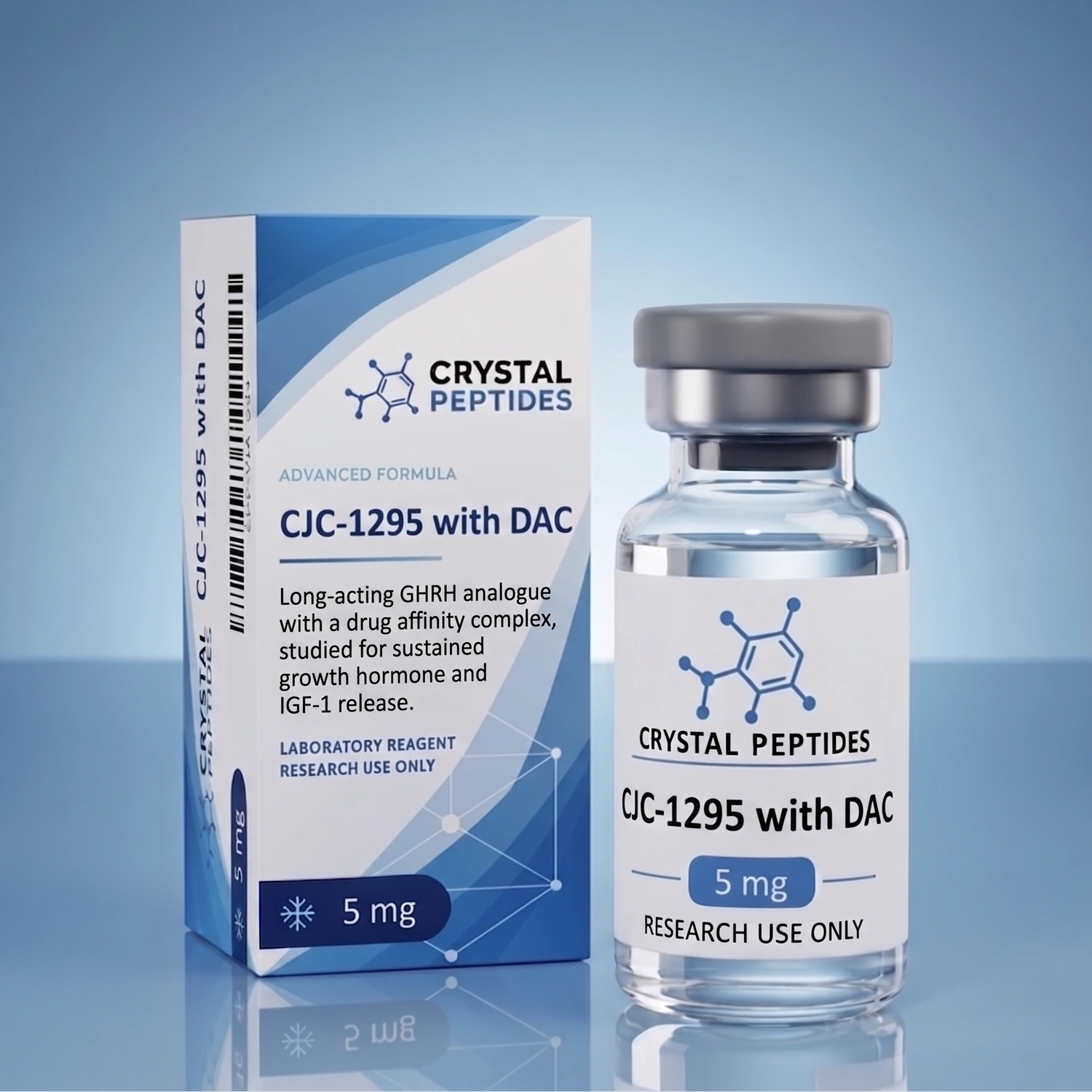
CJC-1295 mit DAC (5mg)
5mg
❄️Lyophilisiertes Pulver (nicht rekonstituiert)
Gesamt: 41.51 CHF
Rabatt pro Menge
| Menge | Rabatt | Preis pro Einheit |
|---|---|---|
| 5 - 10 | 10% | 37.36 CHF |
| 11 - 20 | 15% | 35.29 CHF |
| 21+ | 20% | 33.21 CHF |
Strenge Tests durch unabhängige Labore
Jede Charge unserer Forschungschemikalien und Peptide wird von einem unabhängigen Labor auf Reinheit und Identität geprüft.
Gesamt: 41.51 CHF
Title-Tag | CJC-1295 mit DAC 5mg | 99% Reinheit | Crystal Peptides |
Meta-Beschreibung | CJC-1295 mit DAC 5mg für die Laborforschung von Crystal Peptides. 99%+ Reinheit, unabhängig getestet, schneller Versand in die EU. Nur für Forschungszwecke. |
CJC-1295 with DAC ist ein langwirksames synthetisches Peptid, das für die Erforschung der Regulation der Wachstumshormonsekretion entwickelt wurde. Es handelt sich um ein modifiziertes Analogon des Wachstumshormon-Releasing-Hormons (GHRH), das für eine verlängerte Aktivierung des hypophysären GHRH-Rezeptors konzipiert wurde und es Forschenden ermöglicht, die anhaltende Stimulation der Wachstumshormon/Insulin-like-Growth-Factor-1-Achse (GH/IGF-1) zu untersuchen.
Forschende innerhalb der Europäischen Union können CJC-1295 with DAC 5 mg von Crystal Peptides als hochreine Forschungssubstanz beziehen, die unabhängig von akkreditierten Laboren geprüft wird, mit chargenspezifischen Analysenzertifikaten zur Verifizierung von Identität und analytischer Qualität.
Dieses Peptid eignet sich besonders gut für die Forschung, da natives humanes GHRH im Blutkreislauf sehr schnell abgebaut wird und nur eine Plasmahalbwertszeit von wenigen Minuten aufweist. CJC-1295 wurde entwickelt, um diese Einschränkung durch gezielte Aminosäuresubstitutionen zu überwinden, die die enzymatische Stabilität verbessern. CJC-1295 with DAC ist konkret mit einem Drug Affinity Complex (DAC) formuliert, der die Zirkulationszeit durch eine stabilere kovalente Bindung an Serumalbumin verlängert. Dadurch kann das Peptid seine biologische Aktivität über Tage statt über Minuten aufrechterhalten.
Was ist das Peptid CJC-1295 with DAC?
Das Peptid CJC-1295 ist ein synthetisches Peptidanalogon, das von der biologisch aktiven N-terminalen Region des GHRH abgeleitet ist, welche die für die Stimulation der Wachstumshormonfreisetzung aus den somatotrophen Zellen der Hypophyse verantwortliche Rezeptorbindungssequenz enthält. Es wurden mehrere Aminosäuresubstitutionen eingeführt, um die Anfälligkeit für enzymatischen Abbau zu verringern und gleichzeitig die Rezeptoraffinität zu erhalten, sodass CJC-1295 das pharmakologische Profil von GHRH beibehält und dabei eine deutlich verbesserte Stabilität unter physiologischen Bedingungen zeigt.
Bei CJC-1295 with DAC wird der Drug Affinity Complex an das Hauptmolekül angefügt. DAC ist kein separates Trägerprotein und kein Bestandteil der Formulierung. Es handelt sich vielmehr um eine reaktive Maleimidopropionamid-Gruppe, die direkt an das Peptid gebunden ist und nach der Verabreichung eine stabile kovalente Bindung mit einem freien Cysteinrest des zirkulierenden Albumins eingeht. Albumin fungiert als natürlich reichlich vorhandenes Transportprotein, das das Peptid vor schneller renaler Clearance und enzymatischem Abbau schützt und das aktive Molekül gleichzeitig allmählich freisetzt.
Diese Albuminbindungsstrategie verlängert die Eliminationshalbwertszeit von Minuten auf etwa eine Woche und unterscheidet CJC-1295 with DAC von kurzwirksamen GHRH-Analoga.
Was ist der Unterschied zwischen CJC-1295 with DAC, CJC-1295 no DAC und Modified GRF (1-29)?
Die Terminologie rund um dieses Peptid ist oft verwirrend, da in der wissenschaftlichen Literatur und auf dem Markt für Forschungspeptide unterschiedliche Bezeichnungen verwendet werden. Modified GRF (1-29) ist die wissenschaftliche Bezeichnung für das GHRH-Analogon mit den vier Substitutionen, das häufig als CJC-1295 without DAC oder CJC-1295 no DAC vermarktet wird. Diese Bezeichnungen beziehen sich auf dasselbe Peptid.
CJC-1295 with DAC wurde anschließend von ConjuChem entwickelt, indem ein Drug Affinity Complex (DAC) an das Peptid Modified GRF (1-29) angefügt wurde. Der DAC ermöglicht eine stabile kovalente Bindung an zirkulierendes Serumalbumin, wodurch die Verweildauer des Peptids im Blutkreislauf drastisch verlängert wird. Folglich teilen sich CJC-1295 with DAC und Modified GRF (1-29) dasselbe modifizierte GHRH-Peptidgerüst und dieselbe Rezeptorpharmakologie, unterscheiden sich jedoch erheblich in ihren pharmakokinetischen Profilen, wobei die DAC-Formulierung eine in Tagen statt in Minuten gemessene Halbwertszeit aufweist. Diese Unterscheidung ist grundlegend und sollte bei der Interpretation veröffentlichter Forschung berücksichtigt werden.
Trotz dieser pharmakokinetischen Unterschiede teilen sich beide Verbindungen denselben grundlegenden Wirkmechanismus. Im Gegensatz zum rekombinanten humanen Wachstumshormon (rHGH), das direkt an peripheren Wachstumshormonrezeptoren wirkt, wirken sowohl Modified GRF (1-29) als auch CJC-1295 with DAC vorgelagert in der endokrinen Signalkaskade, indem sie den Wachstumshormon-Releasing-Hormon-Rezeptor (GHRHR) aktivieren. Dies stimuliert die endogene Wachstumshormonsekretion unter Beibehaltung der normalen physiologischen Rückkopplungsmechanismen und ermöglicht es Forschenden, die Regulation der GH/IGF-1-Achse, die pulsatile Hormonfreisetzung und die endokrine Signalübertragung zu untersuchen.
Das verlängerte pharmakokinetische Profil von CJC-1295 with DAC macht es besonders gut geeignet für Studien zur anhaltenden Aktivierung des GHRH-Rezeptors.
Chemische Eigenschaften und Registrierungsdaten
Eigenschaft | Wert |
Name und Synonyme | CJC-1295 with DAC, CJC-1295 DAC, Drug Affinity Complex CJC-1295 |
PubChem-CID | 91971820 |
CAS-Nummer | 446262-90-4 |
Summenformel | C165H269N47O46 |
Molekulargewicht | 3647,2 g/mol |
Peptidlänge | 30 Aminosäuren (modifiziertes GHRH-Analogon) |
Verbindungsklasse | Langwirksames GHRH-Analogon |
Primäres Ziel | Wachstumshormon-Releasing-Hormon-Rezeptor (GHRHR) |
Wirkmechanismus | GHRHR-Agonist mit albuminbindendem Drug Affinity Complex (DAC) |
Halbwertszeit | Etwa 6–8 Tage in klinischen Studien |
Strukturelle Merkmale | Vier Aminosäuresubstitutionen für erhöhte Stabilität; Maleimidopropionamid-Drug-Affinity-Complex, der eine kovalente Albuminbindung ermöglicht |
Physikalische Form | Weißes bis cremefarbenes lyophilisiertes Pulver, 5 mg |
Löslichkeit | Löslich in 1%iger Essigsäure und physiologischen Puffern; begrenzt löslich in reinem Wasser, DMSO oder Ethanol |
Entwickler | ConjuChem Biotechnologies |
Reinheit | Siehe Analysenzertifikat (COA) |
Durchstechflaschengrößen | CJC-1295 with DAC 5mg |
Einige Punkte verdienen besondere Beachtung, da sie häufig falsch dargestellt werden.
CJC-1295 with DAC ist ein Peptid aus 30 Aminosäuren. Obwohl es vom humanen Wachstumshormon-Releasing-Hormon (GHRH) abgeleitet ist, handelt es sich nicht um das vollständige Hormon mit 44 Resten, sondern um ein entwickeltes Analogon, das auf dessen biologisch aktiver N-terminaler Region basiert.
Das oben genannte Molekulargewicht gilt speziell für die DAC-Version. Modified GRF (1-29), oft vermarktet als „CJC-1295 no DAC“, verfügt nicht über den Drug Affinity Complex und weist daher ein geringeres Molekulargewicht sowie deutlich andere pharmakokinetische Eigenschaften auf.
Der Drug Affinity Complex ist ein integraler Bestandteil des Moleküls. Er wird nicht separat geliefert oder ist nicht bereits an Albumin gebunden. Nach der Verabreichung reagiert die Maleimidopropionamid-Gruppe mit zirkulierendem Serumalbumin und bildet eine stabile kovalente Bindung, die die Verweildauer des Peptids im Blutkreislauf erheblich verlängert. Diese Albuminbindungsstrategie ist das entscheidende Merkmal, das CJC-1295 with DAC von kurzwirksamen GHRH-Analoga unterscheidet.
Im Folgenden finden Sie eine überarbeitete Fassung, die sich stilistisch enger an die Cagrilintide-Seite anlehnt. Sie konzentriert sich auf die kleine, aber aussagekräftige klinische Evidenzbasis, vermeidet eine künstliche Aufblähung der Studienanzahl und hebt den jeweiligen Beitrag jeder Publikation hervor.
Klinische Daten zu CJC-1295 with DAC
Die veröffentlichte klinische Literatur zu CJC-1295 with DAC ist relativ begrenzt, aber ungewöhnlich aufschlussreich. Anders als bei vielen Forschungspeptiden wurden bei CJC-1295 mehrere frühe klinische Studien zu Pharmakokinetik, Pharmakodynamik, endokrinen Effekten und Sicherheit abgeschlossen, bevor die Entwicklung eingestellt wurde. Der Großteil der verfügbaren Evidenz betrifft daher die Physiologie des Wachstumshormons und nicht langfristige therapeutische Ergebnisse.
Klinisches Phase-1-Programm (Teichman et al., Journal of Clinical Endocrinology & Metabolism, 2006)
Vierundzwanzig gesunde Erwachsene nahmen an einer Dosiseskalationsstudie teil, in der sowohl einmalige als auch wiederholte subkutane Verabreichungen von CJC-1295 untersucht wurden. Einzeldosen von 30 bis 1.000 µg/kg führten zu anhaltenden, dosisabhängigen Anstiegen der zirkulierenden Wachstumshormonkonzentrationen über sechs Tage oder länger sowie zu erhöhten Plasma-IGF-1-Konzentrationen für etwa 9 bis 11 Tage. Die geschätzte Eliminationshalbwertszeit lag zwischen 5,8 und 8,1 Tagen, was die verlängerten Albuminbindungseigenschaften des Drug Affinity Complex widerspiegelt. Im Mehrfachdosis-Teil der Studie hielt die wiederholte wöchentliche Gabe die erhöhten IGF-1-Konzentrationen bis zu 28 Tage lang aufrecht, was einen kumulativen pharmakodynamischen Effekt ohne Anzeichen von Tachyphylaxie zeigte. CJC-1295 wurde im Allgemeinen gut vertragen; leichte Reaktionen an der Injektionsstelle, Hitzewallungen und Kopfschmerzen waren die am häufigsten berichteten behandlungsbedingten Beobachtungen. [1]
Studie zur Wachstumshormon-Pulsatilität (Ionescu et al., Journal of Clinical Endocrinology & Metabolism, 2006)
Eine der zentralen Fragen im Zusammenhang mit langwirksamen GHRH-Analoga ist, ob eine anhaltende Rezeptorstimulation das normale pulsatile Muster der endogenen Wachstumshormonsekretion unterdrückt. Eine detaillierte endokrine Profilerstellung zeigte, dass CJC-1295 die mittlere Wachstumshormonsekretion, die Wachstumshormonkonzentrationen und den zirkulierenden IGF-1 signifikant erhöhte, während die physiologische Pulsatilität erhalten blieb. Anstatt die endogene Hormonfreisetzung durch kontinuierliche Stimulation zu ersetzen, verstärkte das Peptid die natürlich auftretenden sekretorischen Pulse, wodurch es sich mechanistisch von der exogenen Verabreichung von rekombinantem Wachstumshormon unterscheidet.[2]
Zusammengenommen begründeten diese Studien die charakteristischen pharmakologischen Eigenschaften von CJC-1295 with DAC. Natives GHRH hat eine im Blutkreislauf messbare Halbwertszeit von Minuten, während der albuminbindende Drug Affinity Complex die biologische Aktivität auf etwa eine Woche verlängert und dabei die endogene hypophysäre Regulation erhält. Diese Kombination aus verlängerter Exposition und physiologischer Hormonfreisetzung bleibt die wesentliche wissenschaftliche Begründung für die Verbindung und erklärt ihre fortgesetzte Verwendung als Forschungswerkzeug zur Untersuchung der GH/IGF-1-Achse.
Über diese frühen Untersuchungen hinaus sind die veröffentlichten Humandaten begrenzt. Spätere Arbeiten untersuchten vor allem nachgelagerte Biomarker der GH/IGF-1-Aktivierung statt der klinischen Wirksamkeit und zeigten messbare Veränderungen in der Serumproteinexpression nach Verabreichung von CJC-1295, was zusätzliche Einblicke in die biologischen Folgen der anhaltenden GHRH-Rezeptoraktivierung liefert. [3]
Die Entwicklung von CJC-1295 führte in keiner Region zu einer behördlichen Zulassung oder Marktzulassung. Obwohl die Verbindung in die klinische Entwicklung der Phase II eintrat, wurde das Programm eingestellt, und keine Formulierung von CJC-1295 with DAC wurde von der Europäischen Arzneimittel-Agentur (EMA), der US-amerikanischen Food and Drug Administration (FDA) oder einer anderen nationalen Arzneimittelbehörde zugelassen.
Das aktuelle Verständnis des Peptids beruht daher auf veröffentlichter Pharmakologie und frühen klinischen Untersuchungen und nicht auf einer zugelassenen therapeutischen Anwendung.
Forschungsanwendungen von CJC-1295 with DAC
CJC-1295 with DAC ist ein weit verbreitetes Forschungswerkzeug zur Untersuchung der langfristigen Aktivierung des Wachstumshormon-Releasing-Hormon-Rezeptors (GHRH) und der physiologischen Regulation der GH/IGF-1-Achse. Die verlängerte Halbwertszeit der Verbindung unterscheidet sie von nativem GHRH und kurzwirksamen Analoga und ermöglicht es Forschenden, eine anhaltende endokrine Signalübertragung bei gleichzeitiger Erhaltung der endogenen Hypophysenfunktion zu untersuchen.
Regulation der Wachstumshormon- und IGF-1-Achse
CJC-1295 bietet ein Modell zur Untersuchung der anhaltenden Stimulation des GHRH-Rezeptors und ihrer nachgelagerten Auswirkungen auf die Wachstumshormon- und IGF-1-Sekretion. Da das Peptid die endogene Hormonfreisetzung stimuliert, anstatt Wachstumshormon direkt zu ersetzen, wird es häufig zur Untersuchung endokriner Rückkopplungsmechanismen, der Hypophysenreaktivität und der physiologischen Regulation der somatotropen Achse über längere Zeiträume eingesetzt.
Pulsatile Wachstumshormonsekretion
Eines der charakteristischen Merkmale von CJC-1295 ist seine Fähigkeit, die endokrine Aktivität aufrechtzuerhalten, ohne das normale pulsatile Muster der Wachstumshormonfreisetzung aufzuheben. Dadurch ist das Peptid zu einem wichtigen experimentellen Werkzeug geworden, um zu untersuchen, wie eine anhaltende GHRH-Rezeptoraktivierung Pulsfrequenz, Pulsamplitude und die hypothalamisch-hypophysäre Rückkopplung beeinflusst, während die physiologischen sekretorischen Rhythmen erhalten bleiben.
Albuminbindende Wirkstofffreisetzungssysteme
Der Drug Affinity Complex stellt eine der frühesten erfolgreichen Anwendungen der stabilen Albuminbindung zur Verlängerung der Peptidhalbwertszeit dar. Über die Endokrinologie hinaus wird CJC-1295 in der Forschung zu albuminvermittelter Wirkstofffreisetzung, Peptidpharmakokinetik und Strategien zur Verlängerung der systemischen Exposition biologisch aktiver Peptide ohne kontinuierliche Infusion oder häufige Dosierung referenziert.
Vergleichende Endokrinologie
CJC-1295 wird häufig zusammen mit anderen Verbindungen bewertet, die die Wachstumshormonachse beeinflussen, darunter Sermorelin, Modified GRF (1-29) und Wachstumshormon-Sekretagoga wie Ipamorelin. Vergleichende Studien untersuchen weiterhin Unterschiede bei der Rezeptoraktivierung, der Wirkdauer, den endokrinen Reaktionen und den Wechselwirkungen zwischen GHRH-Rezeptoragonisten und Ghrelinrezeptoragonisten und liefern Einblicke in die komplementären Rollen dieser Signalwege.
Biomarker-Entdeckung und Proteinexpression
Die anhaltende Aktivierung der GH/IGF-1-Achse führt zu messbaren Veränderungen zirkulierender Proteine, die an Wachstum, Stoffwechsel, Entzündung und Gewebeumbau beteiligt sind. Proteomanalysen nach Verabreichung von CJC-1295 haben Veränderungen bei mehreren Serumbiomarkern identifiziert, wodurch die Verbindung ein nützliches Werkzeug zur Untersuchung nachgelagerter molekularer Reaktionen auf anhaltende endokrine Stimulation und zur Identifizierung von Kandidaten-Biomarkern im Zusammenhang mit der Wachstumshormon-Signalübertragung darstellt.
Wie CJC-1295 with DAC wirkt (Wirkmechanismus)
CJC-1295 with DAC ist ein langwirksamer Agonist des Wachstumshormon-Releasing-Hormon-Rezeptors (GHRHR), eines G-Protein-gekoppelten Rezeptors der Klasse B, der hauptsächlich auf somatotrophen Zellen der Hypophyse exprimiert wird. Durch die Bindung an diesen Rezeptor stimuliert das Peptid die endogene Wachstumshormonsekretion über denselben physiologischen Weg wie natives GHRH, bleibt jedoch aufgrund seines albuminbindenden Drug Affinity Complex wesentlich länger im Blutkreislauf.
Zielbindung
Unter normalen physiologischen Bedingungen bindet hypothalamisches GHRH an den GHRH-Rezeptor auf hypophysären Somatotrophen und leitet die Freisetzung von gespeichertem Wachstumshormon ein. Natives GHRH wird durch zirkulierende Proteasen rasch abgebaut, wodurch die Rezeptoraktivierung auf wenige Minuten begrenzt ist. CJC-1295 bewahrt die Rezeptorbindungseigenschaften von GHRH und enthält gleichzeitig Aminosäuresubstitutionen, die die metabolische Stabilität verbessern. Der angehängte Drug Affinity Complex verlängert die Exposition zusätzlich, indem er eine stabile kovalente Bindung mit zirkulierendem Serumalbumin eingeht und die Plasmakonzentrationen über mehrere Tage aufrechterhält. [4]
Nachgelagerte Signalwege
Die Aktivierung des GHRH-Rezeptors stimuliert primär den Gs-Signalweg, was zur Aktivierung der Adenylatzyklase, zu erhöhtem intrazellulärem zyklischem AMP (cAMP) und zur anschließenden Aktivierung der Proteinkinase A (PKA) führt. Diese Signalereignisse fördern die Synthese, Speicherung und Sekretion von Wachstumshormon aus hypophysären Somatotrophen. Zusätzliche nachgelagerte Wege, einschließlich der CREB-vermittelten Gentranskription und calciumabhängiger Sekretionsmechanismen, tragen nach der Rezeptoraktivierung zu anhaltenden endokrinen Reaktionen bei. [5]
Endokrine Effekte
Das als Reaktion auf CJC-1295 freigesetzte Wachstumshormon wirkt auf mehrere periphere Gewebe, insbesondere auf die Leber, wo es die Synthese und Freisetzung von Insulin-like Growth Factor 1 (IGF-1) stimuliert. Wachstumshormon übt zudem direkte, von IGF-1 unabhängige Stoffwechseleffekte aus, wodurch das Peptid ein nützliches Modell darstellt, um die primäre Wachstumshormon-Signalübertragung von der nachgelagerten, IGF-1-vermittelten Physiologie zu unterscheiden. Da CJC-1295 vorgelagert an der Wachstumshormonsekretion ansetzt, anstatt das Hormon selbst zu ersetzen, bleiben die endokrinen Rückkopplungsmechanismen unter Beteiligung von Somatostatin und zirkulierendem IGF-1 intakt. [3]
Erhaltung der physiologischen Hormonsekretion
Eines der charakteristischen Merkmale von CJC-1295 with DAC ist, dass eine anhaltende Rezeptorstimulation keine kontinuierliche Wachstumshormonfreisetzung bewirkt. Klinische Untersuchungen haben gezeigt, dass die endogene Sekretion trotz anhaltender Rezeptoraktivierung pulsatil bleibt, wobei das Peptid natürlich auftretende sekretorische Pulse verstärkt, anstatt sie zu überschreiben. Dies unterscheidet CJC-1295 von exogenem rekombinantem Wachstumshormon und macht es besonders wertvoll für die Untersuchung der physiologischen Regulation der GH/IGF-1-Achse. [2]
Pharmakokinetischer Vorteil des DAC
Der Drug Affinity Complex verändert das Verhalten des Peptids im Blutkreislauf grundlegend. Anstatt die Rezeptorpotenz zu erhöhen, verlängert die DAC-Modifikation die systemische Exposition, indem sie die renale Clearance reduziert und das Peptid durch kovalente Bindung an zirkulierendes Serumalbumin vor schnellem enzymatischem Abbau schützt. Diese pharmakokinetische Strategie verlängert die Eliminationshalbwertszeit auf etwa eine Woche und ermöglicht es Forschenden, die anhaltende GHRH-Rezeptoraktivierung zu untersuchen, ohne die häufige Verabreichung, die für natives GHRH oder kurzwirksame Analoga wie Modified GRF (1-29) erforderlich ist.
CJC-1295 with DAC im Vergleich zu verwandten Forschungssubstanzen
CJC-1295 with DAC gehört zur Familie der Wachstumshormon-Releasing-Hormon-Analoga (GHRH), wird jedoch häufig mit Verbindungen gruppiert, die über völlig unterschiedliche Mechanismen wirken. Manche stimulieren den GHRH-Rezeptor, andere aktivieren den Ghrelinrezeptor, während rekombinantes Wachstumshormon die Hypophyse vollständig umgeht. Es ist aufschlussreicher zu verstehen, an welcher Stelle jede Verbindung innerhalb der Wachstumshormonachse wirkt, als lediglich Wirkstärke oder Wirkdauer zu vergleichen.
CJC-1295 with DAC | ||||
Typ | Langwirksames synthetisches GHRH-Analogon | Kurzwirksames synthetisches GHRH-Analogon | Synthetischer Ghrelinrezeptor-Agonist (GHRP) | Synthetisches GHRH-Analogon |
Primäres Ziel | GHRH-Rezeptor (GHRHR) | GHRH-Rezeptor (GHRHR) | Wachstumshormon-Sekretagogen-Rezeptor (GHSR-1a) | GHRH-Rezeptor (GHRHR) |
Wirkmechanismus | Stimuliert die endogene GH-Sekretion durch anhaltende GHRHR-Aktivierung | Stimuliert die endogene GH-Sekretion durch vorübergehende GHRHR-Aktivierung | Stimuliert die endogene GH-Sekretion über die Ghrelin-Signalübertragung | Ahmt natives GHRH nach |
Hauptmerkmal | Der Drug Affinity Complex ermöglicht eine anhaltende Albuminbindung | Schneller Wirkeintritt und kurze Wirkdauer ohne DAC | Aktiviert einen ergänzenden Rezeptorweg zu GHRH | Ähnelt eng der endogenen GHRH-Physiologie |
Ungefähre Halbwertszeit | 5,8–8,1 Tage | Etwa 30 Minuten | Etwa 2 Stunden | Etwa 10–20 Minuten |
Primäre Forschungsanwendung | Langfristige endokrine Physiologie und GH/IGF-1-Achsenforschung | Studien zur pulsatilen GHRH-Signalübertragung | Forschung zur Ghrelin-Signalübertragung und kombinierten Sekretagoga | Native GHRH-Physiologie |
Status | Forschungssubstanz | Forschungssubstanz | Forschungssubstanz | Forschungssubstanz |
Der Vergleich lässt sich am besten verstehen, wenn man betrachtet, an welcher Stelle jede Verbindung innerhalb der endokrinen Achse wirkt. CJC-1295 with DAC, Modified GRF (1-29) und Sermorelin stimulieren alle denselben Rezeptor, unterscheiden sich jedoch deutlich in ihrer Pharmakokinetik. Sermorelin ähnelt dem endogenen GHRH am stärksten, Modified GRF (1-29) verbessert die Stabilität, bleibt aber kurzwirksam, und CJC-1295 with DAC verlängert die Rezeptoraktivierung durch Albuminbindung auf etwa eine Woche.
Ipamorelin nimmt eine völlig andere Position ein, da es den Wachstumshormon-Sekretagogen-Rezeptor (GHSR-1a) bzw. den Ghrelinrezeptor aktiviert und nicht den GHRHR. Da diese Signalwege jedoch komplementär sind, werden die beiden Substanzklassen in experimentellen Modellen zur Untersuchung der endogenen Wachstumshormonregulation häufig gemeinsam bewertet.
Qualität und Testung
Jede Charge CJC-1295 with DAC von Crystal Peptides wird mit analytischen Methoden wie der Hochleistungsflüssigkeitschromatographie (HPLC) getestet. Diese Tests werden von unabhängigen Drittlaboren wie Janoshik durchgeführt, wobei ein Analysenzertifikat auf den Produktseiten oder auf unserer speziellen Labortests-Seite verfügbar ist. Diese COAs können beim Testlabor verifiziert werden, was Forschenden einen höheren Standard an Rückverfolgbarkeit bietet als bei anderen Unternehmen, die gemeinsam genutzte Dokumentation verwenden.
Insbesondere langwirksame Peptidanaloga stellen analytische Anforderungen, die über die einfache Reinheitsmessung hinausgehen. Der in dieser Formulierung enthaltene Drug Affinity Complex trägt wesentlich zur molekularen Identität von CJC-1295 with DAC bei, weshalb eine Bestätigung durch Massenspektrometrie zusammen mit der chromatographischen Reinheitsprüfung besonders wertvoll ist.
Beachten Sie jedoch, dass ein hoher HPLC-Testwert nicht ausreicht, um CJC-1295 with DAC von kürzeren GHRH-Analoga zu unterscheiden oder das Vorhandensein der albuminbindenden Modifikation zu bestätigen.
Auch Handhabung und Lagerung spielen eine wichtige Rolle für die Erhaltung der Peptidintegrität. Obwohl CJC-1295 with DAC wesentlich stabiler als natives GHRH ist, kann ein Peptidabbau dennoch durch wiederholte Gefrier-Tau-Zyklen, längere Exposition gegenüber erhöhten Temperaturen oder unsachgemäße Rekonstitutionspraktiken auftreten.
Dieses Forschungsmaterial wird in lyophilisierter (gefriergetrockneter) Form geliefert und sollte bis zur Verwendung versiegelt bleiben. Rekonstituierte Lösungen sollten unter geeigneten Kühlbedingungen gelagert werden, um den Abbau im Laufe der Zeit zu minimieren.
Regulatorische und rechtliche Hinweise
Alle von Crystal Peptides gelieferten Produkte sind ausschließlich für Forschungs- und Entwicklungszwecke bestimmt. Diese Materialien werden ausschließlich als Laborreagenzien für wissenschaftliche Untersuchungen geliefert und sind nicht für die Anwendung an Menschen oder Tieren zugelassen.
Dieses Produkt ist kein Arzneimittel, Lebensmittel, Nahrungsergänzungsmittel, Medizinprodukt oder Kosmetikum. CJC-1295 with DAC wurde von der Europäischen Arzneimittel-Agentur (EMA), der US-amerikanischen Food and Drug Administration (FDA) oder einer anderen nationalen Arzneimittelbehörde nicht als Arzneimittel zugelassen.
Obwohl die Verbindung in die frühe klinische Entwicklung eintrat und eine anhaltende Stimulation der endogenen Sekretion von Wachstumshormon und Insulin-like Growth Factor 1 zeigte, führte die klinische Entwicklung letztlich nicht zu einer Marktzulassung. Alle Aussagen zu der Verbindung stammen aus veröffentlichter wissenschaftlicher Literatur und wurden von keiner Regulierungsbehörde bewertet. Diese Materialien sind nicht zur Diagnose, Behandlung, Heilung oder Vorbeugung von Krankheiten bestimmt.
Materialien dürfen nur von entsprechend qualifizierten Fachkräften gehandhabt werden, die in laborwissenschaftlichen Forschungsverfahren geschult sind. Die Einführung dieses Produkts in Menschen oder Tiere ist untersagt und kann gegen geltende Gesetze und Vorschriften verstoßen. Als Käufer sind Sie dafür verantwortlich, sicherzustellen, dass Erwerb, Einfuhr, Lagerung, Handhabung, Verwendung und Entsorgung den in Ihrem Land geltenden Rechtsvorschriften entsprechen. Die nationalen Anforderungen an Forschungschemikalien unterscheiden sich von Land zu Land.
LABORREAGENZ, NUR FÜR FORSCHUNGSZWECKE. Kein Arzneimittel und kein Lebensmittel. Nicht für den menschlichen Verzehr bestimmt.
Quellen und Referenzen
Teichman SL, Neale A, Lawrence B, et al. Prolonged stimulation of growth hormone (GH) and insulin-like growth factor I secretion by CJC-1295, a long-acting analog of GH-releasing hormone, in healthy adults. Journal of Clinical Endocrinology & Metabolism. 2006;91(3):799-805. PMID: 16352683
Ionescu M, Frohman LA. Pulsatile secretion of growth hormone (GH) persists during continuous stimulation by CJC-1295, a long-acting GH-releasing hormone analog. Journal of Clinical Endocrinology & Metabolism. 2006;91(12):4792-4797. PMID: 17018654
Sackmann-Sala L, Ding J, Frohman LA, et al. Activation of the GH/IGF-1 axis by CJC-1295, a long-acting GHRH analog, results in serum protein profile changes in normal adult subjects. Growth Hormone & IGF Research. 2009;19(6):471-477. PMID: 19386527
Dieguez C, López M, Casanueva F. Hypothalamic GHRH. Reviews in Endocrine and Metabolic Disorders. 2025;26(3):297-303. PMID: 39913072
Halmos G, Szabo Z, Dobos N, et al. Growth hormone-releasing hormone receptor (GHRH-R) and its signaling. Reviews in Endocrine and Metabolic Disorders. 2025;26(3):343-352. PMID: 39934495
Häufig gestellte Fragen
Was ist CJC-1295 with DAC?
CJC-1295 with DAC ist ein langwirksames synthetisches Analogon des Wachstumshormon-Releasing-Hormons (GHRH), das für die endokrine und peptidbezogene Forschung entwickelt wurde. Es stimuliert den Wachstumshormon-Releasing-Hormon-Rezeptor (GHRHR) in der Hypophyse und fördert die endogene Wachstumshormonsekretion unter Erhaltung der physiologischen endokrinen Rückkopplung. Im Gegensatz zu kurzwirksamen GHRH-Analoga enthält es einen Drug Affinity Complex (DAC), der die systemische Exposition durch stabile kovalente Bindung an zirkulierendes Serumalbumin verlängert, wodurch es ein wertvolles Forschungswerkzeug zur Untersuchung der anhaltenden Aktivierung der GH/IGF-1-Achse ist.
Was ist der Unterschied zwischen CJC-1295 with DAC und CJC-1295 ohne DAC?
Der Hauptunterschied ist das Vorhandensein des Drug Affinity Complex. Modified GRF (1-29), auch bekannt als CJC-1295 without DAC oder CJC-1295 no DAC, enthält dasselbe modifizierte GHRH-Peptidgerüst, jedoch nicht die albuminbindende DAC-Modifikation. Infolgedessen hat CJC-1295 without DAC eine im Blutkreislauf messbare Halbwertszeit von Minuten, während CJC-1295 with DAC etwa eine Woche im Blutkreislauf verbleibt. Obwohl beide Peptide denselben Rezeptor aktivieren und denselben grundlegenden Wirkmechanismus teilen, unterscheiden sich ihre pharmakokinetischen Profile und Forschungsanwendungen erheblich.
Wie wirkt CJC-1295 with DAC?
CJC-1295 with DAC wirkt als Agonist des Wachstumshormon-Releasing-Hormon-Rezeptors (GHRHR), der sich auf somatotrophen Zellen der Hypophyse befindet. Die Aktivierung dieses Rezeptors stimuliert die endogene Wachstumshormonsynthese und -sekretion über den normalen hypothalamisch-hypophysären Signalweg. Klinische Studien haben gezeigt, dass das Peptid trotz seiner verlängerten Zirkulationszeit die physiologische pulsatile Wachstumshormonsekretion beibehält, anstatt sie durch eine kontinuierliche exogene Hormonexposition zu ersetzen.
Welche klinischen Studien wurden zu CJC-1295 with DAC veröffentlicht?
Die einflussreichsten Humanstudien wurden 2006 im Journal of Clinical Endocrinology & Metabolism veröffentlicht. Diese Phase-I-Untersuchungen zeigten anhaltende Anstiege des zirkulierenden Wachstumshormons und des Insulin-like Growth Factor 1 (IGF-1) nach Verabreichung von CJC-1295 with DAC bei gleichzeitiger Erhaltung der physiologischen pulsatilen Hormonsekretion. Nachfolgende Forschung untersuchte Veränderungen der Serumproteinprofile im Zusammenhang mit der Aktivierung der GH/IGF-1-Achse und trug so zu einem umfassenderen Verständnis der Pharmakologie und der endokrinen Effekte des Peptids bei.
Warum erhielt CJC-1295 with DAC keine Marktzulassung?
Obwohl CJC-1295 with DAC die frühe klinische Entwicklung durchlief und günstige pharmakokinetische und pharmakodynamische Eigenschaften zeigte, wurde die Entwicklung nicht bis zur Marktzulassung fortgesetzt. Folglich bleibt die veröffentlichte Evidenz auf frühe klinische Untersuchungen und Laborforschung beschränkt, und die Verbindung wurde von der Europäischen Arzneimittel-Agentur (EMA) oder anderen großen Arzneimittelbehörden nicht als Arzneimittel zugelassen.
Wird CJC-1295 with DAC ausschließlich für Forschungszwecke geliefert?
Ja. Crystal Peptides liefert CJC-1295 with DAC ausschließlich als Laborforschungsreagenz. Das Produkt ist ausschließlich für wissenschaftliche Untersuchungen bestimmt und ist kein Arzneimittel, Lebensmittel, Nahrungsergänzungsmittel oder Tierarzneimittel. Es ist nicht zur Diagnose, Behandlung, Heilung oder Vorbeugung von Krankheiten bestimmt und darf nicht an Menschen oder Tieren angewendet werden.
Stellt Crystal Peptides ein Analysenzertifikat (COA) bereit?
Ja. Jede Charge wird mit einem chargenspezifischen Analysenzertifikat geliefert, das direkt auf das unabhängige Testlabor zurückgeführt werden kann. Das COA ermöglicht es Forschenden, die Identität, Reinheit und analytischen Eigenschaften der genauen gelieferten Charge zu überprüfen, bevor sie in experimentelle Arbeiten einbezogen wird. Crystal Peptides unterhält zudem eine eigene COA-Bibliothek, in der Forschende die analytische Dokumentation einzelner Chargen einsehen können.
Wie wird CJC-1295 with DAC getestet?
Jedes von Crystal Peptides verkaufte Produkt durchläuft vor der Freigabe eine umfassende Qualitätskontrolle. Die analytische Testung umfasst HPLC-Reinheitsanalysen, die Verifizierung der molekularen Identität sowie unabhängige Tests durch akkreditierte Drittlabore wie Janoshik Analytical. Je nach Produkt und Charge können zusätzliche Tests auf Peptidgehalt, Endotoxine, Sterilität und Schwermetalle durchgeführt werden, was Forschenden Vertrauen in Qualität, Identität und Reproduzierbarkeit des gelieferten Materials gibt.
Welche Durchstechflaschengröße bietet Crystal Peptides an?
Crystal Peptides liefert CJC-1295 with DAC derzeit in lyophilisierten Forschungsfläschchen zu 5 mg. Aktuelle Verfügbarkeit, Preise und begleitende analytische Dokumentation werden auf der Produktseite angezeigt. Crystal Peptides bietet außerdem CJC-1295 no DAC in 5-mg- und 10-mg-Fläschchen an; erhalten Sie CJC-1295-Peptid in einer hochreinen Formulierung, die durch unabhängige Tests verifiziert wurde.
Wie sollte CJC-1295 with DAC rekonstituiert und gelagert werden?
CJC-1295 with DAC wird als lyophilisiertes Pulver geliefert und typischerweise im Labor mit bakteriostatischem Wasser oder sterilem Wasser rekonstituiert. Das Lösungsmittel sollte langsam entlang der Innenwand des Fläschchens eingebracht werden, damit sich das Peptid ohne starkes Schütteln natürlich auflösen kann. Nach der Rekonstitution sollte die Lösung gekühlt bei 2–8 °C gelagert und vor wiederholten Gefrier-Tau-Zyklen geschützt werden. Nicht rekonstituierte Fläschchen sollten versiegelt, trocken, lichtgeschützt und vorzugsweise bei -20 °C oder darunter gelagert werden, bis sie für die Forschung benötigt werden.
Wo kann ich CJC-1295 5mg with DAC in Europa kaufen?
Wenn Sie sich innerhalb der Europäischen Union befinden, können Sie CJC-1295 with DAC 5mg von Crystal Peptides in sehr hoher Reinheit und Qualität kaufen. Jede Charge wird unabhängig von akkreditierten Laboren getestet und jeder Charge liegt ein Analysenzertifikat bei. Beachten Sie, dass es sich um eine Forschungssubstanz handelt, die innerhalb der EU ausschließlich für Laborforschungszwecke versandt wird und hochreine Peptide zur Unterstützung der Forschung an Bildungseinrichtungen, Laboren und unabhängigen Forschenden bereitstellt.
Versendet Crystal Peptides CJC-1295 with DAC europaweit?
Ja. Crystal Peptides versendet Forschungspeptide europaweit mit nachverfolgbaren Zustelldiensten und diskreter Verpackung. Bestellungen werden in der Regel schnell versandt, wobei die Lieferzeiten je nach Zielland variieren, und für viele Standorte ist ein Expressversand verfügbar. Forschende können voraussichtliche Lieferzeiten, Versandoptionen und Zahlungsmethoden, einschließlich gängiger Kartenanbieter und weiterer unterstützter Zahlungslösungen, vor der Bestellung einsehen. Kaufen Sie CJC-1295 with DAC 5mg von Crystal Peptides; vollständige Versandinformationen und länderspezifische Lieferhinweise sind auf Anfrage erhältlich.