
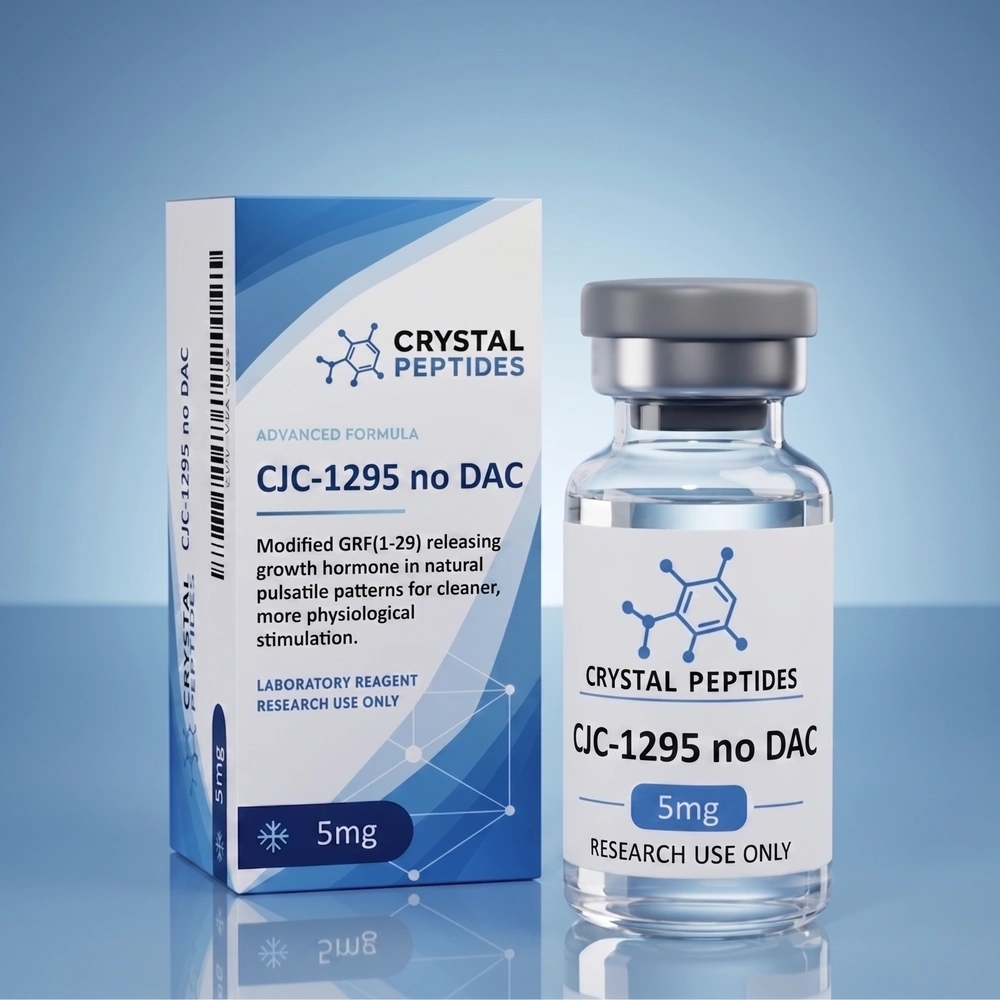
CJC-1295 no DAC (5mg)
❄️Lyophilisiertes Pulver (nicht rekonstituiert)
Größe:
Gesamt: 35.05 CHF
Rabatt pro Menge
| Menge | Rabatt | Preis pro Einheit |
|---|---|---|
| 5 - 9 | 10% | 31.55 CHF |
| 10 - 19 | 20% | 28.04 CHF |
| 20+ | 30% | 24.54 CHF |
Strenge Tests durch unabhängige Labore
Jede Charge unserer Forschungschemikalien und Peptide wird von einem unabhängigen Labor auf Reinheit und Identität geprüft.
Gesamt: 35.05 CHF
Versand Montag, 26. Okt.
Annahmeschluss 15:00 Uhr OEZ
Ankunft Mo., 2. Nov. – Mi., 4. Nov.
Kostenloser Versandschutz
Verlorene oder beschädigte Pakete werden ersetzt
Expresszustellung in 1–3 Tagen
Wählbar an der Kasse
CJC-1295 no DAC ist ein synthetisches Analogon des Growth-Hormone-Releasing-Hormons (GHRH), das entwickelt wurde, um den hypophysären GHRH-Rezeptor (GHRHR) zu stimulieren und dabei eine höhere metabolische Stabilität als natives GHRH aufzuweisen. Das Peptid leitet sich von der biologisch aktiven 29-Aminosäuren-Region des humanen GHRH ab und enthält vier gezielte Aminosäuresubstitutionen, die die Resistenz gegenüber enzymatischem Abbau verbessern, während die Rezeptoraffinität und die physiologische Rezeptorsignalübertragung erhalten bleiben.
Im Gegensatz zu rekombinantem humanem Wachstumshormon (rHGH) stimuliert CJC-1295 no DAC die endogene Wachstumshormonsekretion, indem es den GHRH-Rezeptor vorgelagert innerhalb der Hypothalamus-Hypophysen-Achse aktiviert. Seine relativ kurze Wirkdauer ermöglicht es Forschenden, die Regulierung der Wachstumshormon/Insulin-like-Growth-Factor-1(GH/IGF-1)-Achse, endokrine Rückkopplungsmechanismen, Rezeptorpharmakologie und die physiologische pulsatile Wachstumshormonsekretion unter Bedingungen zu untersuchen, die dem nativen GHRH-Signalweg deutlich näherkommen als bei lang wirksamen GHRH-Analoga.
Forschende innerhalb der Europäischen Union können CJC-1295 no DAC 5mg bei Crystal Peptides als hochreine Forschungssubstanzen erwerben, die unabhängig von akkreditierten Laboren geprüft werden, wobei jede Produktcharge mit einem Analysezertifikat (Certificate of Analysis) zur Verifizierung von Identität, Reinheit und analytischer Qualität versehen ist.
CJC-1295 no DAC vs. CJC-1295 with DAC vs. Modified GRF (1-29)
Obwohl CJC-1295 no DAC und CJC-1295 with DAC dasselbe modifizierte GHRH-Grundgerüst teilen und denselben Rezeptor aktivieren, unterscheiden sie sich grundlegend in ihrem pharmakokinetischen Verhalten. CJC-1295 with DAC enthält einen Drug Affinity Complex, der eine stabile kovalente Bindung mit zirkulierendem Serumalbumin eingeht und dadurch die Halbwertszeit von etwa 30 Minuten auf rund eine Woche verlängert.
CJC-1295 no DAC weist diese albuminbindende Modifikation nicht auf und ist daher das bevorzugte Forschungswerkzeug, wenn eine vorübergehende Rezeptoraktivierung und physiologische endokrine Signalübertragung im Mittelpunkt der Untersuchung stehen.
Modified GRF (1-29) ist wiederum die wissenschaftliche Bezeichnung für das Peptid, das üblicherweise als CJC-1295 without DAC oder CJC-1295 no DAC vermarktet wird. Alle drei Bezeichnungen beziehen sich auf dasselbe GHRH-Analogon mit vier Substitutionen. Die alternative Marktbezeichnung wurde lediglich eingeführt, um das Peptid von CJC-1295 with DAC abzugrenzen, das den zusätzlichen Drug Affinity Complex enthält und daher wesentlich andere pharmakokinetische Eigenschaften aufweist.
Chemische Eigenschaften und Registrierungsdaten
Eigenschaft | Wert |
Name und Synonyme | CJC-1295 without DAC, Modified GRF (1-29), Mod GRF (1-29), Tetrasubstituted GRF (1-29) |
PubChem CID | 91976842 |
CAS-Nummer | 863288-34-0 |
Summenformel | C152H252N44O42 |
Molekulargewicht | 3367.9 g/mol |
Peptidlänge | 29 Aminosäuren |
Substanzklasse | Kurzwirksames GHRH-Analogon |
Primäres Zielmolekül | Growth-Hormone-Releasing-Hormon-Rezeptor (GHRHR) |
Wirkmechanismus | GHRHR-Agonist |
Halbwertszeit | Etwa 30 Minuten |
Strukturelle Merkmale | Vier Aminosäuresubstitutionen (D-Ala², Gln⁸, Ala¹⁵, Leu²⁷); kein Drug Affinity Complex (DAC) |
Physikalische Form | Weißes bis cremefarbenes lyophilisiertes Pulver |
Löslichkeit | Bakteriostatisches oder steriles Wasser |
Entwicklung | Basiert auf dem modifizierten GHRH(1-29)-Forschungsanalogon |
Reinheit | Siehe COA |
Verfügbare Fläschchengrößen | CJC-1295 without DAC 5 mg, 10 mg |
Klinische Daten zu CJC-1295 no DAC
Im Gegensatz zu CJC-1295 with DAC war CJC-1295 without DAC nicht Gegenstand eines eigenen klinischen Entwicklungsprogramms. Die wichtigsten veröffentlichten Studien betreffen lang wirksame GHRH-Analoga, die die albuminbindende DAC-Formulierung untersuchen.
Modified GRF (1-29) wurde vor allem durch Peptid-Engineering, Rezeptorpharmakologie und Laborforschung charakterisiert. Dennoch teilen sich die beiden Verbindungen dasselbe modifizierte GHRH-Peptidgrundgerüst und somit denselben grundlegenden Mechanismus der Rezeptoraktivierung.
Beobachtungen zum DAC-Analogon liefern wichtige Erkenntnisse zur Pharmakologie des modifizierten Peptids selbst, während das Fehlen des Drug Affinity Complex dazu führt, dass CJC-1295 without DAC eine wesentlich kürzere Rezeptoraktivierung und ein deutlich anderes pharmakokinetisches Profil aufweist.
Die hier besprochenen Beobachtungen dienen daher ausschließlich der Beschreibung der pharmakologischen Eigenschaften der Verbindung und sind nicht als Unterstützung einer klinischen Anwendung zu verstehen. CJC-1295 no DAC wird ausschließlich für Forschungszwecke geliefert.
Entwicklung von Modified GRF (1-29)
CJC-1295 no DAC wurde aus dem biologisch aktiven 29-Aminosäuren-Fragment des humanen GHRH entwickelt, indem vier Aminosäuresubstitutionen eingeführt wurden, die die Resistenz gegenüber enzymatischem Abbau verbessern und gleichzeitig die Affinität zum Growth-Hormone-Releasing-Hormon-Rezeptor (GHRHR) erhalten. Im Gegensatz zu nativem GHRH, das durch Enzyme wie Dipeptidylpeptidase IV (DPP-IV) rasch inaktiviert wird, weist Modified GRF (1-29) eine verbesserte metabolische Stabilität auf, während die kurze Dauer der Rezeptoraktivierung erhalten bleibt, die für physiologische Studien der pulsatilen Wachstumshormonsekretion erforderlich ist. [1]
Verhältnis zu CJC-1295 with DAC
Die vier Aminosäuresubstitutionen, die in Modified GRF (1-29) vorliegen, bilden auch das Peptidgrundgerüst von CJC-1295 with DAC. Klinische Studien zum DAC-Analogon zeigten, dass diese Substitutionen die endogene Pulsatilität des Wachstumshormons erhalten, während sie gleichzeitig die zirkulierenden Konzentrationen von Wachstumshormon und Insulin-like Growth Factor-1 (IGF-1) erhöhen. [1]
Der wesentliche pharmakokinetische Unterschied zwischen den beiden Molekülen ist der zusätzliche Drug Affinity Complex, der die Halbwertszeit des DAC-Analogons durch Albuminbindung von Minuten auf etwa eine Woche verlängert. Ohne diese Modifikation bleibt CJC-1295 without DAC ein kurzwirksames GHRH-Analogon, das für eine vorübergehende Rezeptoraktivierung statt für eine anhaltende endokrine Stimulation konzipiert ist.
Dennoch wirken beide Verbindungen über denselben gut charakterisierten GHRH-Rezeptor wie endogenes GHRH, und dessen Pharmakologie ist durch jahrzehntelange Forschung zur hypothalamischen Wachstumshormonregulation, zum Peptid-Engineering und zur GHRH-Rezeptorsignalübertragung bekannt.
Aktuelle Übersichtsarbeiten verwenden Modified GRF (1-29) weiterhin als Beispiel dafür, wie gezielte Aminosäuresubstitutionen die Peptidstabilität verbessern können, ohne die physiologische Rezeptorfunktion grundlegend zu verändern.
Keine Formulierung von CJC-1295 wurde von der Europäischen Arzneimittel-Agentur (EMA), der US-amerikanischen Food and Drug Administration (FDA) oder einer anderen großen Arzneimittelbehörde als Arzneimittel zugelassen. Unser aktuelles Verständnis der Verbindung beruht auf veröffentlichter Pharmakologie, Peptidchemie und endokriner Forschung, nicht auf einer zugelassenen therapeutischen Anwendung.
Hinweis: Für Studien, die komplementäre endokrine Signalwege untersuchen, wird CJC-1295 without DAC häufig mit Ipamorelin kombiniert, insbesondere in der CJC-1295 & Ipamorelin Blend (5mg). Während Modified GRF (1-29) den GHRH-Rezeptor stimuliert, aktiviert Ipamorelin selektiv den Growth-Hormone-Secretagogue-Rezeptor (GHSR-1a), wodurch die Kombination ein weithin untersuchtes Forschungsmodell für die endogene Wachstumshormonregulation darstellt. |
Forschungsanwendungen von CJC-1295 No DAC
CJC-1295 without DAC wird hauptsächlich als Forschungswerkzeug zur Untersuchung der kurzfristigen Aktivierung des Growth-Hormone-Releasing-Hormon-Rezeptors (GHRHR) und der physiologischen Regulierung der Wachstumshormon/Insulin-like-Growth-Factor-1(GH/IGF-1)-Achse eingesetzt. Im Gegensatz zu lang wirksamen GHRH-Analoga ermöglicht seine relativ kurze Halbwertszeit Forschenden, vorübergehende endokrine Reaktionen zu untersuchen, die der natürlichen pulsatilen Freisetzung von hypothalamischem GHRH deutlich näherkommen.
Pulsatile Wachstumshormonphysiologie
Die wichtigste Forschungsanwendung von CJC-1295 without DAC ist die Untersuchung der physiologischen Pulsatilität des Wachstumshormons. Da das Peptid nach der Rezeptoraktivierung rasch eliminiert wird, bietet es ein nützliches Modell zur Untersuchung von Zeitpunkt, Amplitude und Frequenz der endogenen Wachstumshormonsekretion ohne anhaltende Rezeptorbesetzung. Dies macht es besonders wertvoll für Studien zur Hypothalamus-Hypophysen-Regulation und zu endokrinen Rückkopplungsmechanismen. [1]
Pharmakologie des Growth-Hormone-Releasing-Hormon-Rezeptors
Modified GRF (1-29) wird häufig zur Untersuchung der Pharmakologie des GHRH-Rezeptors und der intrazellulären Signalwege, die die Synthese und Sekretion von Wachstumshormon regulieren, eingesetzt. Durch den Erhalt der Rezeptorbindungseigenschaften von nativem GHRH bei gleichzeitig verbesserter metabolischer Stabilität ermöglicht das Peptid Forschenden, Rezeptoraktivierung, Ligand-Rezeptor-Interaktionen und nachgeschaltete Signalwege unter kontrollierten experimentellen Bedingungen zu untersuchen. [2]
Vergleichende Studien zu GHRH-Analoga
CJC-1295 without DAC wird häufig gemeinsam mit nativem GHRH, Sermorelin und CJC-1295 with DAC untersucht, um zu erforschen, wie strukturelle Veränderungen die Peptidstabilität, die Rezeptoraktivierung und das pharmakokinetische Verhalten beeinflussen. Diese vergleichenden Studien haben zu einem umfassenderen Verständnis dessen beigetragen, wie Peptid-Engineering die metabolische Stabilität verbessern kann, ohne die Rezeptorpharmakologie grundlegend zu verändern.
Kombinierte Signalübertragung mit Growth-Hormone-Secretagogues
Da der GHRH-Rezeptor und der Growth-Hormone-Secretagogue-Rezeptor (GHSR-1a) die Wachstumshormonsekretion über komplementäre Signalwege regulieren, wird CJC-1295 without DAC häufig gemeinsam mit Ghrelin-Rezeptor-Agonisten wie Ipamorelin untersucht. Experimentelle Modelle nutzen diese Verbindungen, um Rezeptor-Cross-Talk, endokrine Regulation und die koordinierte Steuerung der endogenen Wachstumshormonfreisetzung zu untersuchen.
Peptid-Engineering und metabolische Stabilität
Die vier Aminosäuresubstitutionen in Modified GRF (1-29) sind zu einem vielzitierten Beispiel für rationales Peptid-Engineering geworden. Forschende untersuchen weiterhin, wie gezielte strukturelle Veränderungen die Resistenz gegenüber enzymatischem Abbau verbessern, während die Rezeptoraffinität erhalten bleibt, und liefern damit Erkenntnisse zu Strategien zur Verlängerung der Peptidstabilität ohne albuminbindende Technologien oder andere lang wirksame Freisetzungssysteme.
Wie CJC-1295 without DAC wirkt (Wirkmechanismus)
CJC-1295 without DAC ist ein Agonist des Growth-Hormone-Releasing-Hormon-Rezeptors (GHRHR), eines G-Protein-gekoppelten Rezeptors der Klasse B, der vorwiegend auf somatotropen Zellen des Hypophysenvorderlappens exprimiert wird. Durch die Bindung an diesen Rezeptor stimuliert das Peptid die endogene Wachstumshormonsekretion über denselben physiologischen Signalweg wie natives GHRH, weist dabei aber aufgrund von vier gezielten Aminosäuresubstitutionen eine höhere Resistenz gegenüber enzymatischem Abbau auf. Im Gegensatz zu CJC-1295 with DAC enthält es keine albuminbindende Modifikation und bewirkt daher eine vorübergehende statt eine anhaltende Rezeptoraktivierung.
Zielinteraktion
Unter physiologischen Bedingungen bindet hypothalamisches GHRH an den GHRH-Rezeptor auf somatotropen Zellen der Hypophyse und leitet die Synthese und Sekretion von Wachstumshormon ein. Natives GHRH wird durch zirkulierende Proteasen, insbesondere Dipeptidylpeptidase IV (DPP-IV), rasch abgebaut, wodurch seine biologische Aktivität auf nur wenige Minuten begrenzt ist.
CJC-1295 without DAC behält die Rezeptorbindungseigenschaften von nativem GHRH bei und weist gleichzeitig die vier Aminosäuresubstitutionen D-Ala², Gln⁸, Ala¹⁵ und Leu²⁷ auf, die die Resistenz gegenüber enzymatischem Abbau verbessern, ohne die Rezeptorspezifität zu verändern. [3]
Zudem sind die vier Aminosäuresubstitutionen in Modified GRF (1-29) ein wichtiges Beispiel für rationales Peptid-Engineering, das zeigt, wie gezielte strukturelle Veränderungen die biologische Aktivität verlängern können, ohne die physiologische Rezeptorfunktion grundlegend zu verändern.
Nachgeschaltete Signalwege
Die Aktivierung des GHRH-Rezeptors stimuliert vorwiegend den Gs-Signalweg, aktiviert die Adenylatzyklase und erhöht das intrazelluläre zyklische AMP (cAMP). Erhöhtes cAMP aktiviert die Proteinkinase A (PKA), was zur Phosphorylierung von Transkriptionsfaktoren wie CREB führt und die Synthese und Sekretion von Wachstumshormon fördert. Kalziumabhängige Signalwege tragen ebenfalls zur Hormonfreisetzung bei und koordinieren die Exozytose von gespeichertem Wachstumshormon aus somatotropen Zellen der Hypophyse. [3]
Endokrine Wirkungen
Das als Reaktion auf CJC-1295 without DAC freigesetzte Wachstumshormon wirkt auf mehrere periphere Gewebe, insbesondere die Leber, wo es die Produktion von Insulin-like Growth Factor-1 (IGF-1) stimuliert. Da das Peptid die endogene Hormonfreisetzung stimuliert, anstatt Wachstumshormon direkt zuzuführen, bleibt die normale endokrine Rückkopplung unter Beteiligung von Somatostatin, GHRH und zirkulierendem IGF-1 erhalten. Dies macht die Verbindung zu einem wertvollen Forschungswerkzeug zur Untersuchung der physiologischen Regulation der somatotropen Achse.
Vorübergehende Rezeptoraktivierung
Das entscheidende pharmakokinetische Merkmal von CJC-1295 without DAC ist seine relativ kurze Wirkdauer. Obwohl die vier Aminosäuresubstitutionen die metabolische Stabilität im Vergleich zu nativem GHRH verbessern, bleibt das Peptid ein kurzwirksames Analogon, da es den für die Albuminbindung verantwortlichen Drug Affinity Complex nicht enthält.
Die daraus resultierende vorübergehende Rezeptoraktivierung ähnelt der endogenen hypothalamischen GHRH-Signalübertragung deutlich stärker und ermöglicht es Forschenden, die Wachstumshormonsekretion unter Bedingungen zu untersuchen, die das normale endokrine Timing erhalten.
Vergleich CJC-1295 no DAC vs. CJC-1295 with DAC vs. Ipamorelin vs. Sermorelin
CJC-1295 without DAC wird meist mit anderen wachstumshormonbezogenen Peptiden gruppiert, obwohl sich diese Verbindungen sowohl in ihren Rezeptorzielen als auch in ihren pharmakokinetischen Profilen erheblich unterscheiden.
CJC-1295 without DAC | ||||
Typ | Kurzwirksames synthetisches GHRH-Analogon | Langwirksames synthetisches GHRH-Analogon | Synthetischer Ghrelin-Rezeptor-Agonist (GHRP) | Synthetisches GHRH-Analogon |
Primäres Zielmolekül | GHRH-Rezeptor (GHRHR) | GHRH-Rezeptor (GHRHR) | Growth-Hormone-Secretagogue-Rezeptor (GHSR-1a) | GHRH-Rezeptor (GHRHR) |
Wirkmechanismus | Stimuliert die endogene GH-Sekretion durch vorübergehende GHRHR-Aktivierung | Stimuliert die endogene GH-Sekretion durch anhaltende GHRHR-Aktivierung | Stimuliert die endogene GH-Sekretion über Ghrelin-Signalübertragung | Ahmt endogenes GHRH nach |
Hauptmerkmal | Vier stabilisierende Aminosäuresubstitutionen ohne Albuminbindung | Drug Affinity Complex ermöglicht anhaltende Albuminbindung | Aktiviert einen zu GHRH komplementären endokrinen Signalweg | Ähnelt stark der nativen GHRH-Physiologie |
Ungefähre Halbwertszeit | Etwa 30 Minuten | Etwa 5,8–8,1 Tage | Etwa 2 Stunden | Etwa 10–20 Minuten |
Hauptforschungsbereich | Pulsatile GH-Physiologie und vorübergehende endokrine Signalübertragung | Langzeitforschung zur GH/IGF-1-Achse | Ghrelin-Signalübertragung und Forschung zu kombinierten Secretagogues | Native GHRH-Physiologie |
Klinischer Status | Forschungssubstanz | In Prüfung | In Prüfung | In ausgewählten Ländern zugelassenes Arzneimittel |
Qualität und Prüfung
Crystal Peptides verpflichtet sich zur Einhaltung höchster Standards bei Peptidqualität und -reinheit. Jede Charge durchläuft eine HPLC-Reinheitsanalyse sowie unabhängige Drittprüfungen durch akkreditierte Labore, darunter Janoshik Analytical. Die Prüfung geht über die chromatographische Reinheit hinaus und umfasst auch den Peptidgehalt, die Sterilität, den Endotoxin- und den Schwermetallnachweis, sodass Forschende eine umfassende Bewertung der Produktqualität erhalten.
Jedes Produkt wird mit einem chargenspezifischen Analysezertifikat geliefert, das direkt auf das Prüflabor und die exakt analysierte Charge zurückverfolgt werden kann. Dies ermöglicht es Forschenden, Produktidentität, Reinheit und Eignung für die Laborforschung anhand transparenter, nachvollziehbarer Analysedaten unabhängig zu überprüfen.
Als kurzwirksames GHRH-Analogon erfordert CJC-1295 without DAC die Bestätigung sowohl der Reinheit als auch der molekularen Identität. Während HPLC die chromatographische Reinheit bestätigt, verifizieren ergänzende Verfahren wie LC-MS, dass es sich um das korrekte Peptid handelt, und unterscheiden Modified GRF (1-29) von strukturell verwandten GHRH-Analoga, einschließlich CJC-1295 with DAC. Zusammen bieten diese analytischen Methoden ein höheres Maß an Sicherheit hinsichtlich der Identität und Integrität des Forschungsmaterials.
Eine sachgemäße Handhabung und Lagerung ist ebenso wichtig für den Erhalt der Peptidstabilität. CJC-1295 without DAC wird als lyophilisiertes Pulver geliefert und sollte versiegelt, trocken und lichtgeschützt gelagert werden, vorzugsweise bei -20°C oder darunter, bis es für die Forschung benötigt wird. Nach der Rekonstitution mit bakteriostatischem oder sterilem Wasser sollte die Lösung bei 2–8°C gekühlt, vor Kontamination geschützt und im Rahmen der im jeweiligen Labor festgelegten Stabilitätsprotokolle verwendet werden.
Praktiken wie wiederholte Gefrier-Auftau-Zyklen, längere Exposition gegenüber erhöhten Temperaturen und starkes Schütteln sollten vermieden werden, da jede dieser Praktiken den Peptidabbau beschleunigen und die Probenintegrität beeinträchtigen kann.
Regulatorische und rechtliche Hinweise
Alle von Crystal Peptides gelieferten Produkte sind ausschließlich für Forschungs- und Entwicklungszwecke bestimmt. Diese Materialien werden ausschließlich als Laborreagenzien für die wissenschaftliche Untersuchung geliefert und sind nicht für die Anwendung am Menschen oder am Tier zugelassen.
Dieses Produkt ist kein Arzneimittel, Lebensmittel, Nahrungsergänzungsmittel, Medizinprodukt oder Kosmetikum. CJC-1295 without DAC wurde weder von der Europäischen Arzneimittel-Agentur (EMA) noch von der US-amerikanischen Food and Drug Administration (FDA) oder einer anderen nationalen Arzneimittelbehörde als Arzneimittel zugelassen. Obwohl das Peptid im Bereich Peptid-Engineering, Rezeptorpharmakologie und endokrine Forschung umfassend charakterisiert wurde, hat es die für eine Zulassung erforderliche klinische Entwicklung nicht durchlaufen.
Sämtliche Aussagen zu dieser Verbindung beruhen auf veröffentlichter wissenschaftlicher Literatur und wurden von keiner Regulierungsbehörde bewertet. Diese Materialien sind nicht zur Diagnose, Behandlung, Heilung oder Vorbeugung von Krankheiten bestimmt.
Die Materialien dürfen nur von entsprechend qualifizierten Fachpersonen gehandhabt werden, die in Laborforschungsverfahren geschult sind. Die Anwendung dieses Produkts am Menschen oder am Tier ist untersagt und kann gegen geltende Gesetze und Vorschriften verstoßen. Käufer sind dafür verantwortlich sicherzustellen, dass Erwerb, Einfuhr, Lagerung, Handhabung, Verwendung und Entsorgung den in ihrer jeweiligen Rechtsordnung geltenden Vorschriften entsprechen. Die nationalen Anforderungen an Forschungschemikalien unterscheiden sich von Land zu Land.
LABORREAGENZ, AUSSCHLIESSLICH FÜR FORSCHUNGSZWECKE. Kein Arzneimittel oder Lebensmittel. Nicht für den menschlichen Verzehr bestimmt.
Quellen und Referenzen
- Lumpkin MD, Mulroney SE, Haramati A. Inhibition of pulsatile growth hormone (GH) secretion and somatic growth in immature rats with a synthetic GH-releasing factor antagonist. Endocrinology. 1989;124(3):1154-1159.
- Jetté L, Léger R, Thibaudeau K, et al. Human growth hormone-releasing factor (hGRF)1-29-albumin bioconjugates activate the GRF receptor on the anterior pituitary in rats: identification of CJC-1295 as a long-lasting GRF analog. Endocrinology. 2005;146(7):3052-3058.
- Halmos G, Szabo Z, Dobos N, et al. Growth hormone-releasing hormone receptor (GHRH-R) and its signaling. Reviews in Endocrine and Metabolic Disorders. 2025;26(3):343-352.
- Sackmann-Sala L, Ding J, Frohman LA, et al. Activation of the GH/IGF-1 axis by CJC-1295, a long-acting GHRH analog, results in serum protein profile changes in normal adult subjects. Growth Hormone & IGF Research. 2009;19(6):471-477.
Häufig gestellte Fragen
Was ist CJC-1295 without DAC?
CJC-1295 without DAC ist ein kurzwirksames synthetisches Analogon des Growth-Hormone-Releasing-Hormons (GHRH), auch bekannt als Modified GRF (1-29). Es stimuliert den Growth-Hormone-Releasing-Hormon-Rezeptor (GHRHR) im Hypophysenvorderlappen und fördert die endogene Wachstumshormonsekretion, während die normale physiologische endokrine Rückkopplung erhalten bleibt. Im Gegensatz zu CJC-1295 with DAC enthält es keinen Drug Affinity Complex und bewirkt daher eine vorübergehende Rezeptoraktivierung mit einer zirkulierenden Halbwertszeit von etwa 30 Minuten.
Was ist der Unterschied zwischen CJC-1295 without DAC und CJC-1295 with DAC?
Der wesentliche Unterschied ist das Vorhandensein des Drug Affinity Complex (DAC). Modified GRF (1-29), das üblicherweise als CJC-1295 without DAC oder CJC-1295 no DAC vermarktet wird, enthält dasselbe modifizierte GHRH-Peptidgrundgerüst, jedoch nicht die albuminbindende DAC-Modifikation. Folglich bleibt CJC-1295 without DAC ein kurzwirksames Peptid, während CJC-1295 with DAC etwa eine Woche im Kreislauf verbleibt. Obwohl beide denselben Rezeptor aktivieren und denselben grundlegenden Wirkmechanismus teilen, werden sie aufgrund ihrer erheblich unterschiedlichen pharmakokinetischen Profile für unterschiedliche Bereiche der Laborforschung eingesetzt.
Wie wirkt CJC-1295 without DAC?
CJC-1295 without DAC wirkt als Agonist des Growth-Hormone-Releasing-Hormon-Rezeptors (GHRHR) und stimuliert die endogene Synthese und Sekretion von Wachstumshormon über den normalen Hypothalamus-Hypophysen-Signalweg. Seine vier Aminosäuresubstitutionen verbessern die metabolische Stabilität, während die physiologische Rezeptoraktivierung erhalten bleibt, sodass Forschende die pulsatile Wachstumshormonsekretion, endokrine Rückkopplung und die Regulation der GH/IGF-1-Achse unter Bedingungen untersuchen können, die der nativen GHRH-Aktivität stark ähneln.
Warum wurden die vier Aminosäuresubstitutionen in Modified GRF (1-29) eingeführt?
Modified GRF (1-29) enthält vier gezielte Aminosäuresubstitutionen: D-Ala², Gln⁸, Ala¹⁵ und Leu²⁷. Diese wurden eingeführt, um die Resistenz gegenüber enzymatischem Abbau zu verbessern und dabei die biologische Aktivität am GHRH-Rezeptor zu erhalten, wodurch die biologische Stabilität des Peptids verlängert wird, ohne dessen grundlegenden Wirkmechanismus zu verändern oder den albuminbindenden Drug Affinity Complex zu erfordern, der bei CJC-1295 with DAC zum Einsatz kommt.
Wurde CJC-1295 without DAC am Menschen untersucht?
Gezielte klinische Studien am Menschen haben sich hauptsächlich auf CJC-1295 with DAC und nicht auf Modified GRF (1-29) konzentriert. Infolgedessen stammt die veröffentlichte Evidenz zu CJC-1295 without DAC überwiegend aus Peptid-Engineering, Rezeptorpharmakologie, endokriner Physiologie und Laborforschung, die dessen Wirkmechanismus und biologische Eigenschaften charakterisieren.
Wird CJC-1295 without DAC ausschließlich für Forschungszwecke geliefert?
Ja. Crystal Peptides liefert CJC-1295 without DAC in Europa als Laborforschungsreagenz. Das Produkt ist ausschließlich für die wissenschaftliche Untersuchung bestimmt und ist kein Arzneimittel, Lebensmittel, Nahrungsergänzungsmittel oder Tierarzneimittel. Es ist nicht zur Diagnose, Behandlung, Heilung oder Vorbeugung von Krankheiten bestimmt und darf nicht am Menschen oder am Tier angewendet werden.
Stellt Crystal Peptides ein Analysezertifikat (COA) zur Verfügung?
Ja. Jede von Crystal Peptides zum Verkauf angebotene Charge von CJC-1295 no DAC wird mit einem chargenspezifischen Analysezertifikat geliefert, das direkt auf das unabhängige Prüflabor zurückverfolgt werden kann. Das COA ermöglicht es Forschenden, Identität, Reinheit und analytische Merkmale der jeweils gelieferten Charge zu überprüfen, bevor sie in die experimentelle Arbeit einbezogen wird. Crystal Peptides führt außerdem eine eigene COA-Bibliothek, in der Chargendokumentationen eingesehen werden können.
Wie wird CJC-1295 without DAC geprüft?
Jede Charge durchläuft vor der Freigabe eine umfassende analytische Prüfung. Die Qualitätskontrolle umfasst eine HPLC-Reinheitsanalyse, die Verifizierung der molekularen Identität sowie unabhängige Drittprüfungen durch akkreditierte Labore wie Janoshik Analytical. Je nach Charge können zusätzliche Analysen wie Peptidgehalt, Sterilität, Endotoxin- und Schwermetallprüfung durchgeführt werden, um Forschenden Sicherheit hinsichtlich Produktidentität, Reinheit und Konsistenz zu bieten.
Wie sollte CJC-1295 without DAC rekonstituiert und gelagert werden?
CJC-1295 without DAC wird als lyophilisiertes Pulver geliefert und typischerweise mit bakteriostatischem oder sterilem Wasser rekonstituiert. Das Verdünnungsmittel sollte langsam an der Innenwand des Fläschchens entlang eingeführt werden, damit sich das Peptid auf natürliche Weise ohne starkes Schütteln löst. Nach der Rekonstitution sollte die Lösung bei 2–8°C gekühlt werden, während nicht rekonstituierte Fläschchen versiegelt, trocken, lichtgeschützt und vorzugsweise bei -20°C oder darunter gelagert werden sollten. Wiederholte Gefrier-Auftau-Zyklen und längere Exposition gegenüber erhöhten Temperaturen sollten vermieden werden, um die Peptidintegrität zu erhalten.
Wo kann ich CJC-1295 without DAC für Forschungszwecke kaufen?
Forschende innerhalb der gesamten Europäischen Union können CJC-1295 without DAC (Modified GRF (1-29)) bei Crystal Peptides kaufen. Das Unternehmen versendet CJC-1295 without DAC in ganz Europa mit diskreter Verpackung und nachverfolgbaren Versanddiensten. Bestellungen werden in der Regel zügig versandt, wobei die Lieferzeiten je nach Zielort variieren; für viele europäische Länder steht zudem ein Expressversand zur Verfügung.
Versandoptionen, geschätzte Lieferzeiten, akzeptierte Zahlungsmethoden und länderspezifische Informationen können Sie auf unserer Website einsehen oder sich vor Ihrer Bestellung von unserem freundlichen Support-Team beraten lassen. Unser Ziel ist es, Crystal Peptides zu einer verlässlichen Bezugsquelle für Forschungspeptide in der gesamten EU mit zuverlässiger und sicherer Lieferung zu machen.
Labor-Hinweise von Crystal Peptides
Neue Katalogprodukte, neue Chargenzertifikate sowie Hinweise zu Verfügbarkeit und Lieferzeiten.
Nur an Einkaufs- und Laborkontakte. Jederzeit abbestellbar.