
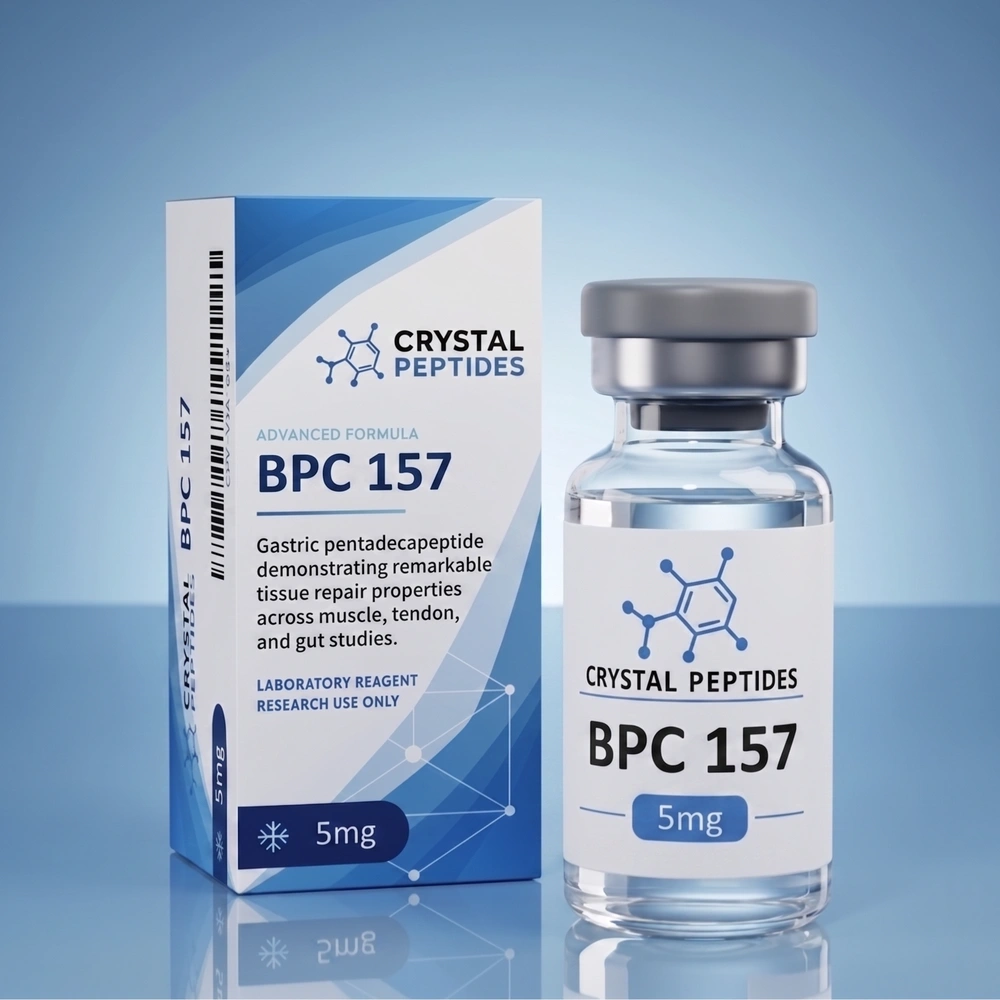
BPC 157 (5mg)
❄️Lyophilisiertes Pulver (nicht rekonstituiert)
Größe:
Gesamt: 24.90 CHF
Rabatt pro Menge
| Menge | Rabatt | Preis pro Einheit |
|---|---|---|
| 5 - 10 | 10% | 22.41 CHF |
| 11 - 20 | 15% | 21.17 CHF |
| 21+ | 20% | 19.92 CHF |
Strenge Tests durch unabhängige Labore
Jede Charge unserer Forschungschemikalien und Peptide wird von einem unabhängigen Labor auf Reinheit und Identität geprüft.
Gesamt: 24.90 CHF
BPC-157 ist ein synthetisches Pentadecapeptid (Peptid aus 15 Aminosäuren), das von einem natürlich vorkommenden Fragment eines Magenproteins abgeleitet ist. In den letzten zwei Jahrzehnten hat es sich zu einem der am intensivsten untersuchten Forschungspeptide in der regenerativen Biologie entwickelt. Veröffentlichte Studien untersuchen seine Wechselwirkungen mit der Physiologie des Bindegewebes, der Angiogenese, der Stickstoffmonoxid-Signalübertragung, Wachstumsfaktor-Signalwegen und zellulären Reparaturmechanismen. Infolgedessen wird BPC-157 in präklinischen experimentellen Modellen häufig als Laborforschungswerkzeug zur Untersuchung der Geweberegeneration und verwandter biologischer Prozesse eingesetzt.
Forscher in der Europäischen Union können BPC-157 5 mg von Crystal Peptides als hochreines Forschungspeptid beziehen, das von akkreditierten Laboren, darunter Janoshik, unabhängig getestet wird. Jede Produktcharge wird von Analysezertifikaten (COA) begleitet, welche Identität, Reinheit und analytische Qualität bestätigen und die Eignung für die Forschung belegen. Diese Zertifikate lassen sich für vollständige Transparenz bis zur Prüfeinrichtung zurückverfolgen.
BPC-157 wurde von der Europäischen Arzneimittel-Agentur (EMA), der US-amerikanischen Food and Drug Administration (FDA) oder einer anderen bedeutenden Arzneimittelbehörde nicht als Arzneimittel zugelassen. Crystal Peptides liefert BPC-157 ausschließlich für die Labor- und Entwicklungsforschung und nicht für den Einsatz am Menschen oder bei Tieren.
Chemische Eigenschaften und Registrierungsdaten
Spezifikation | Details |
Produktname und Synonyme | BPC-157, Body Protection Compound-157; Pentadecapeptid BPC-157 |
Peptidsequenz | GEPPPGKPADDAGLV |
CAS-Nummer | 137525-51-0 |
PubChem-CID | 9941957 |
Summenformel | C62H98N16O22 |
Molekulargewicht | 1419.54 g/mol |
Peptidlänge | 15 Aminosäuren (Pentadecapeptid) |
Erscheinungsbild | Weißes bis cremefarbenes lyophilisiertes Pulver |
Reinheit | Laut COA bestätigen |
Fläschchengrößen | 5 mg, 10 mg |
Löslichkeit | Löslich in bakteriostatischem Wasser oder sterilem Wasser zur Rekonstitution im Labor |
Lagerung (lyophilisiert) | Verschlossen, trocken, lichtgeschützt und vorzugsweise bei -20°C oder darunter lagern |
Lagerung (rekonstituiert) | Bei 2–8°C kühl lagern und wiederholte Gefrier-Tau-Zyklen vermeiden |
Forschungskategorie | Regenerative Biologie, Bindegewebsphysiologie, Peptidforschung |
Verwendungszweck | Ausschließlich für die Laborforschung. Nicht für die Anwendung am Menschen oder bei Tieren. |
Forschungshintergrund und veröffentlichte Studien
BPC-157 wurde in präklinischen Modellen der Bindegewebsbiologie und der regenerativen Forschung umfassend untersucht. Obwohl das genaue molekulare Zielmolekül des Peptids noch nicht vollständig geklärt ist, haben veröffentlichte Studien seine Wechselwirkungen mit der Wachstumsfaktor-Signalübertragung, der Angiogenese, Stickstoffmonoxid-Signalwegen, der Entzündungsregulation und der Zellmigration untersucht. Die hier zusammengestellten Studien gehören zu den wegweisenden Arbeiten, die das heutige wissenschaftliche Verständnis von BPC-157 geprägt haben.
Forscher sollten beachten, dass diese Beobachtungen in erster Linie aus präklinischen Untersuchungen stammen und ausschließlich zur Zusammenfassung der aktuellen wissenschaftlichen Literatur dienen. Sie sind nicht als Nachweis klinischer Wirksamkeit, eines therapeutischen Nutzens oder einer zugelassenen medizinischen Anwendung zu verstehen. Crystal Peptides liefert BPC-157 ausschließlich für die Laborforschung zur wissenschaftlichen Untersuchung verschiedener Anwendungsbereiche.
Sehnenauswuchs, Fibroblastenmigration und Zellüberleben (Chang et al., 2011)
Anhand kultivierter Achillessehnen-Explantate von Ratten zeigten Chang und Kollegen, dass BPC-157 den Sehnenauswuchs beschleunigte, die Fibroblastenmigration verbesserte und das Zellüberleben unter oxidativem Stress steigerte. Das Peptid regte die Fibroblastenproliferation nicht direkt an, was darauf hindeutet, dass seine Wirkungen eher durch eine verbesserte Zellviabilität und Migration als durch eine erhöhte Zellteilung vermittelt wurden. Die Studie identifizierte zudem eine Aktivierung des Signalwegs der fokalen Adhäsionskinase (FAK)-Paxillin, was mechanistische Einblicke liefert, wie BPC-157 die Sehnenbiologie und die Regeneration des Bindegewebes beeinflussen könnte. [1]
Signalübertragung des Wachstumshormonrezeptors (Chang et al., 2014)
Eine anschließende Studie derselben Forschungsgruppe zeigte, dass BPC-157 die Expression des Wachstumshormonrezeptors (GHR) in Sehnenfibroblasten sowohl auf mRNA- als auch auf Proteinebene erhöhte. Durch die gesteigerte Verfügbarkeit des GHR verstärkte eine Vorbehandlung mit BPC-157 die durch Wachstumshormon induzierte Aktivierung des nachgeschalteten JAK2-Signalwegs und lieferte damit zusätzliche mechanistische Belege für die Wechselwirkungen des Peptids mit der Bindegewebsphysiologie. [2]
Forschung zur muskuloskelettalen Regeneration (McGuire et al., 2025)
Ein umfassender narrativer Übersichtsartikel bewertete die wachsende Zahl präklinischer Studien zu BPC-157 in Sehnen-, Band-, Muskel-, Knochen- und Knorpelmodellen. Die Autoren kamen zu dem Schluss, dass die verfügbare experimentelle Literatur ein erhebliches regeneratives Potenzial in mehreren muskuloskelettalen Geweben zeigt, wobei betont wird, dass die Evidenz überwiegend präklinisch bleibt. Für klinische Schlussfolgerungen sind weiterhin klinische Studien am Menschen erforderlich, die strengen regulatorischen Anforderungen entsprechen. Der Übersichtsartikel hebt BPC-157 als wichtiges Forschungswerkzeug zur Untersuchung der regenerativen Biologie und der Bindegewebsphysiologie hervor, nicht als etabliertes Therapeutikum. [3]
Gewebereparatur und regenerative Biologie (Yuan et al., 2026)
Ein aktueller Übersichtsartikel untersuchte die breitere wissenschaftliche Literatur zu BPC-157, einschließlich experimenteller Studien zur Bindegewebsbiologie, Angiogenese, entzündlichen Signalübertragung und nozizeptiven Signalwegen. Die Autoren kamen zu dem Schluss, dass präklinische Befunde zwar weitere Laboruntersuchungen unterstützen, die genauen molekularen Zielstrukturen des Peptids und seine mögliche klinische Bedeutung jedoch nach wie vor nicht vollständig verstanden sind. Der Übersichtsartikel unterstreicht die Notwendigkeit strenger mechanistischer Studien und angemessen konzipierter klinischer Forschung, bevor therapeutische Schlussfolgerungen gezogen werden können. [4]
Diese Beobachtungen sind nicht als Nachweis klinischer Wirksamkeit, eines therapeutischen Nutzens oder einer zugelassenen medizinischen Anwendung zu verstehen. Das Peptid BPC-157 wird ausschließlich als Laborforschungsreagenz für wissenschaftliche Untersuchungen geliefert.
Wirkmechanismus von BPC-157
Trotz umfangreicher präklinischer Forschung wurde das genaue molekulare Zielmolekül von BPC-157 bislang nicht abschließend identifiziert. Anstatt über einen einzelnen Rezeptor zu wirken, deutet die veröffentlichte Forschung darauf hin, dass das Peptid mehrere Signalwege beeinflusst, die an der Bindegewebsphysiologie, der Angiogenese, der Zellmigration, der Entzündungsregulation und der Gewebehomöostase beteiligt sind. Folglich wird BPC-157 im Allgemeinen als pleiotropes Forschungspeptid betrachtet, dessen biologische Aktivität wahrscheinlich durch Wechselwirkungen mit mehreren einander ergänzenden molekularen Mechanismen vermittelt wird.
Experimentelle Studien berichten, dass BPC-157 die Wachstumsfaktor-Signalübertragung moduliert, die an der Bindegewebsbiologie beteiligt ist, einschließlich der mit der Fibroblastenaktivität und der Sehnenphysiologie verbundenen Signalwege. Untersuchungen haben zudem eine erhöhte Expression des Wachstumshormonrezeptors (GHR) in Sehnenfibroblasten gezeigt, zusammen mit einer verstärkten, durch Wachstumshormon induzierten Aktivierung des nachgeschalteten JAK2-Signalwegs, was mechanistische Einblicke in die Wechselwirkungen des Peptids mit Bindegewebszellen liefert.
Ein weiterer aktiver Forschungsbereich betrifft die Stickstoffmonoxid(NO)-Signalübertragung. Experimentelle Studien deuten darauf hin, dass BPC-157 mit Stickstoffmonoxid-abhängigen Signalwegen interagiert, die an der vaskulären Homöostase und der Endothelfunktion beteiligt sind, während andere Untersuchungen Wirkungen auf die angiogene Signalübertragung und die Expression von Mediatoren der Neubildung von Blutgefäßen berichtet haben. Diese Beobachtungen machen BPC-157 zu einem wertvollen Forschungswerkzeug für die Untersuchung der vaskulären Anpassung und der regenerativen Biologie in experimentellen Modellen.
Weitere mechanistische Studien haben eine Aktivierung der fokalen Adhäsionskinase (FAK) und der Paxillin-Signalübertragung in Sehnenfibroblasten identifiziert – Signalwege, die eine zentrale Rolle bei der Zelladhäsion, der Migration und den Wechselwirkungen mit der extrazellulären Matrix spielen. Zusammen mit berichteten Wirkungen auf die Entzündungssignalübertragung und das Zellüberleben unter oxidativem Stress unterstützen diese Befunde die fortgesetzte Untersuchung der Rolle des Peptids in der Bindegewebsbiologie und der Gewebeumstrukturierung.
Obwohl diese mechanistischen Beobachtungen das wissenschaftliche Verständnis von BPC-157 erheblich erweitert haben, sind das primäre molekulare Zielmolekül des Peptids und der relative Beitrag der einzelnen Signalwege nach wie vor nicht vollständig charakterisiert. Die hier beschriebenen vorgeschlagenen Mechanismen sollten daher als Gegenstand laufender präklinischer Forschung betrachtet werden und nicht als gesicherte Erklärungen der biologischen Aktivität oder als Nachweis therapeutischer Wirksamkeit.
Forschungsanwendungen von BPC-157
BPC-157 wurde in zahlreichen Bereichen der regenerativen Biologie untersucht, mit besonderem Schwerpunkt auf der Bindegewebsphysiologie, der Gefäßbiologie und der gastrointestinalen Forschung. Die im Folgenden beschriebenen Anwendungen stammen in erster Linie aus präklinischen Untersuchungen und dienen ausschließlich der Zusammenfassung der aktuellen wissenschaftlichen Literatur. Sie sind nicht als Nachweis klinischer Wirksamkeit, eines therapeutischen Nutzens oder einer zugelassenen medizinischen Anwendung zu verstehen.
Sehnen- und Bindegewebsbiologie
Eine der am intensivsten untersuchten Anwendungen von BPC-157 betrifft die Bindegewebsforschung. Experimentelle Untersuchungen haben das Peptid in Sehnen-, Band-, Muskel-, Knochen- und Knorpelmodellen untersucht, um das Verhalten von Fibroblasten, die Organisation der extrazellulären Matrix, die Kollagenbiologie und die an der Gewebeumstrukturierung beteiligten zellulären Prozesse besser zu verstehen. Diese Studien haben BPC-157 zu einem weit verbreiteten Forschungswerkzeug für die Untersuchung der Bindegewebsphysiologie und der regenerativen Biologie gemacht. [1]
Angiogenese- und Gefäßforschung
BPC-157 wurde außerdem in experimentellen Modellen zur Untersuchung der Angiogenese und der vaskulären Anpassung untersucht. Veröffentlichte Studien und aktuelle Übersichtsartikel haben die Biologie der Endothelzellen, die vaskuläre Homöostase sowie die koordinierten Prozesse der Neubildung von Blutgefäßen im Rahmen der Gewebeumstrukturierung untersucht. Diese Beobachtungen untermauern weiterhin den Einsatz von BPC-157 als Forschungswerkzeug zur Untersuchung vaskulärer Reaktionen im Rahmen umfassenderer regenerativer Modelle. [2]
Gastrointestinale Biologie
Da BPC-157 von einem natürlich vorkommenden Fragment eines Magenproteins abgeleitet ist, konzentrierte sich die frühe Forschung auf gastrointestinale Gewebe und die Schleimhautbiologie. Nachfolgende Laboruntersuchungen haben diese Arbeit auf die Magenphysiologie, die Darmbiologie, die epitheliale Integrität und Entzündungsprozesse ausgeweitet und tragen so zu einem umfassenderen Verständnis der gastrointestinalen Funktion in experimentellen Modellen bei. [1,2]
Regenerative Biologie und experimentelle Modelle
Über einzelne Gewebe hinaus wird BPC-157 häufig in experimentelle Modelle einbezogen, die die regenerative Biologie als Ganzes untersuchen. Die aktuelle Forschung untersucht, wie das Peptid miteinander verknüpfte biologische Prozesse beeinflussen kann, darunter die Zellmigration, die Organisation des Bindegewebes, die vaskuläre Anpassung, die Entzündungsregulation und die Reaktionen auf oxidativen Stress. Zusammengenommen erweitern diese Studien weiterhin das wissenschaftliche Verständnis der komplexen Mechanismen der Geweberegeneration und unterstreichen zugleich die Notwendigkeit weiterer mechanistischer und klinischer Forschung.
BPC-157 im Vergleich zu TB-500, GHK-Cu und KPV
BPC-157 ist eines von mehreren in der regenerativen Biologie untersuchten Peptiden, die jeweils unterschiedliche biologische Ursprünge und wissenschaftliche Interessengebiete aufweisen. Obwohl diese Verbindungen manchmal gemeinsam betrachtet werden, unterscheiden sie sich erheblich in ihrer Struktur, den vorgeschlagenen Wirkmechanismen und den wichtigsten Bereichen der Laborforschung.
BPC-157 | ||||
Peptidklasse | Synthetisches gastrisches Pentadecapeptid | Synthetisches Peptid, das der biologisch aktiven Region von Thymosin beta-4 entspricht | Natürlich vorkommendes kupferbindendes Tripeptid | Synthetisches Tripeptid, abgeleitet von α-MSH |
Herkunft | Abgeleitet von einem natürlich vorkommenden Fragment eines Magenproteins | Abgeleitet von der biologisch aktiven Region von Thymosin beta-4 | Natürlich vorkommendes menschliches Kupferpeptid | Abgeleitet von der C-terminalen Region des alpha-melanozytenstimulierenden Hormons (α-MSH) |
Peptidlänge | 15 Aminosäuren | 43 Aminosäuren | 3 Aminosäuren | 3 Aminosäuren |
Primärer biologischer Schwerpunkt | Bindegewebsbiologie, Angiogenese, Stickstoffmonoxid-Signalübertragung | Zellmigration, zytoskelettale Organisation, Gewebeumstrukturierung | Biologie der extrazellulären Matrix, Kollagenstoffwechsel, kupferabhängige Zellprozesse | Entzündungssignalübertragung, Epithelbiologie, gastrointestinale Physiologie |
Primärer Mechanismus | Mehrere Signalwege werden derzeit untersucht | Mechanismus größtenteils aus der Biologie von Thymosin beta-4 abgeleitet; steht im Zusammenhang mit der G-Aktin-Regulation und der Zellmigration | Modulation der Genexpression, Umbau der extrazellulären Matrix und Kupfertransport | Modulation von Entzündungssignalwegen wird derzeit untersucht |
Wichtigste Forschungsanwendungen | Sehnen-, Band-, Muskel-, Gastrointestinal- und Gefäßbiologie | Gewebeumstrukturierung, Wundheilung, Angiogenese und regenerative Biologie | Hautbiologie, Bindegewebsforschung, kosmetische Wissenschaft und regenerative Biologie | Gastrointestinale Biologie, Epithelforschung, Entzündungsbiologie und Schleimhautphysiologie |
Der wesentliche Unterschied zwischen diesen Peptiden liegt in den biologischen Prozessen, zu deren Untersuchung sie eingesetzt werden. Die Forschung zu BPC-157 konzentriert sich weitgehend auf die Bindegewebsphysiologie, die Angiogenese, die Wachstumsfaktor-Signalübertragung und die gastrointestinale Biologie. Die Forschung zu TB-500 hingegen, die vor allem auf Studien zu Thymosin beta-4 beruht, konzentriert sich auf die zytoskelettale Organisation, die Zellmigration und die Gewebeumstrukturierung.
GHK-Cu wird vor allem im Hinblick auf die Biologie der extrazellulären Matrix, den Kollagenstoffwechsel und die Gewebeumstrukturierung untersucht, während KPV vor allem im Bereich der Entzündungssignalübertragung, der Epithelbiologie und der gastrointestinalen Physiologie auf Interesse stößt.
Für Studien, die komplementäre regenerative Signalwege untersuchen, entscheiden sich manche Forscher für Multi-Peptid-Formulierungen, die Peptide mit unterschiedlichen biologischen Eigenschaften kombinieren. Ein Beispiel ist die BPC-157 & TB-500 combo (5/5-mg-Mischung), die Bindegewebs- und Zytoskelettforschung in einer einzigen co-lyophilisierten Formulierung vereint.
Ebenso umfasst der Glow Blend GHK-Cu, BPC-157 und TB-500 für umfassendere Untersuchungen der Bindegewebsbiologie, des Umbaus der extrazellulären Matrix und regenerativer Prozesse. Diese Formulierungen stellen keine neuen molekularen Entitäten dar; vielmehr handelt es sich um praktische Kombinationen einzeln charakterisierter Forschungspeptide für die Laboruntersuchung.
Qualität und Prüfung
Crystal Peptides verpflichtet sich, Forschungspeptide bereitzustellen, die hohen Standards an analytischer Qualität, Konsistenz und Rückverfolgbarkeit entsprechen. Jede Charge von BPC-157 durchläuft eine HPLC-Reinheitsanalyse sowie eine unabhängige Verifizierung durch akkreditierte Drittlabore, darunter Janoshik Analytical. Die Prüfungen können die Peptididentität, den Peptidgehalt, die Sterilität, den Endotoxingehalt und das Screening auf Schwermetalle umfassen. Chargenspezifische Analysezertifikate stehen zur Verfügung, damit Forscher die analytischen Eigenschaften des jeweils gelieferten Materials überprüfen können.
Da BPC-157 in der Forschung zur regenerativen Biologie häufig eingesetzt wird, sollte die analytische Prüfung sowohl die Peptididentität als auch die Gesamtqualität bestätigen. Forscher sollten auf folgende Analysedaten achten:
- Chromatographische Reinheit mittels Hochleistungsflüssigkeitschromatographie (HPLC) zur Bewertung der Peptidreinheit und zum Nachweis möglicher Verunreinigungen oder Abbauprodukte.
- Molekulare Identität, bestätigt durch Flüssigchromatographie-Massenspektrometrie (LC-MS) zur Bestätigung, dass das Peptid der erwarteten molekularen Masse und Aminosäurezusammensetzung entspricht.
- Peptidgehaltsanalyse, zur Bestätigung, dass jedes Fläschchen die erwartete Menge an BPC-157 enthält.
- Sterilitäts- und Endotoxinprüfung, die dazu beiträgt sicherzustellen, dass das Material für die Laborforschung geeignet ist, bei der eine mikrobiologische Kontamination die experimentellen Ergebnisse beeinträchtigen könnte.
- Schwermetall-Screening, das zusätzliche Sicherheit bietet, dass Rückstände aus der Synthese innerhalb der festgelegten Laborspezifikationen bleiben.
- Chargenspezifische Analysezertifikate (COAs) mit Dokumentation der verwendeten Analysemethoden, Chromatogramme, Laborergebnisse und der unabhängigen Verifizierung für die jeweils gelieferte Charge.
Die gemeinsame Betrachtung dieser Analyseergebnisse bietet ein wesentlich höheres Maß an Sicherheit, als sich allein auf einen angegebenen Reinheitsprozentsatz zu verlassen, und hilft Forschern, die Identität, Zusammensetzung und analytische Qualität des Materials zu überprüfen, bevor es in experimentelle Arbeiten einbezogen wird.
Für die sachgemäße Handhabung und Lagerung wird BPC-157 als lyophilisiertes Pulver geliefert und sollte bis zur Verwendung in der Forschung verschlossen, trocken, lichtgeschützt und vorzugsweise bei -20°C oder darunter gelagert werden.
Rekonstituieren Sie das Präparat mit bakteriostatischem Wasser oder sterilem Wasser. Die Lösung sollte anschließend bei 2–8°C gekühlt, unter geeigneten Laborverfahren gehandhabt und gemäß den etablierten Stabilitätsprotokollen des jeweiligen Labors verwendet werden. Vermeiden Sie wiederholte Gefrier-Tau-Zyklen, längere Einwirkung erhöhter Temperaturen und starkes Schütteln, da diese Praktiken im Laufe der Zeit zum Abbau des Peptids beitragen können.
Regulatorische und rechtliche Hinweise
Alle von Crystal Peptides gelieferten Produkte sind ausschließlich für Forschungs- und Entwicklungszwecke bestimmt. Sie werden ausschließlich als Laborforschungsreagenzien zur Verwendung durch qualifiziertes Fachpersonal in kontrollierten wissenschaftlichen Umgebungen bereitgestellt und nicht für die Anwendung am Menschen oder bei Tieren geliefert.
Dieses Produkt ist kein Arzneimittel, Lebensmittel, Nahrungsergänzungsmittel, Medizinprodukt, Kosmetikum oder Tierarzneimittel. Die auf dieser Seite dargestellten Informationen dienen ausschließlich der Zusammenfassung der aktuellen wissenschaftlichen Literatur und sind nicht als Nachweis klinischer Wirksamkeit, eines therapeutischen Nutzens oder einer zugelassenen medizinischen Anwendung zu verstehen. Verweise auf veröffentlichte Studien beschreiben ausschließlich experimentelle Forschung und wurden von der Europäischen Arzneimittel-Agentur (EMA) oder einer anderen Arzneimittelbehörde nicht im Hinblick auf eine klinische Anwendung bewertet.
BPC-157 wurde von der Europäischen Arzneimittel-Agentur (EMA), der US-amerikanischen Food and Drug Administration (FDA) oder einer anderen bedeutenden Arzneimittelbehörde nicht als Arzneimittel zugelassen. Dementsprechend liefert Crystal Peptides diese Verbindung ausschließlich für die Labor- und Entwicklungsforschung.
Forscher und Käufer sind dafür verantwortlich sicherzustellen, dass der Erwerb, die Einfuhr, die Lagerung, die Handhabung, die Verwendung und die Entsorgung von Forschungsmaterialien allen geltenden nationalen und lokalen Gesetzen und Vorschriften entsprechen. Da die Rechtsvorschriften für Forschungschemikalien je nach Land unterschiedlich sind, sollten Kunden vor dem Kauf oder der Einfuhr von Laborreagenzien die in ihrem eigenen Land geltenden rechtlichen Anforderungen prüfen.
Quellen und Referenzen
- Chang CH, Tsai WC, Lin MS, et al. The promoting effect of pentadecapeptide BPC 157 on tendon healing involves tendon outgrowth, cell survival, and cell migration. Journal of Applied Physiology. 2011;110(3):774-780.
- Chang CH, Tsai WC, Hsu YH, et al. Pentadecapeptide BPC 157 enhances the growth hormone receptor expression in tendon fibroblasts. Molecules. 2014;19(11):19066-19077.
- McGuire FP, Martinez R, Lenz A, et al. Regeneration or Risk? A Narrative Review of BPC-157 for Musculoskeletal Healing. Current Reviews in Musculoskeletal Medicine. 2025;18(12):611-619.
- Yuan C, Demers A, Silva-Ortiz V, et al. From Regeneration to Analgesia: The Role of BPC-157 in Tissue Repair and Pain Management. International Journal of Molecular Sciences. 2026;27(6):2876.
- Sikiric P, Seiwerth S, Skrtic A, et al. BPC 157 Therapy: Targeting Angiogenesis and Nitric Oxide's Cytotoxic and Damaging Actions, but Maintaining, Promoting, or Recovering Their Essential Protective Functions. Comment on Józwiak et al. Multifunctionality and Possible Medical Application of the BPC 157 Peptide—Literature and Patent Review. Pharmaceuticals. 2025;18(10):1450.
Häufig gestellte Fragen
Was ist BPC-157?
BPC-157 ist ein synthetisches Pentadecapeptid (Peptid aus 15 Aminosäuren), das von einem natürlich vorkommenden Fragment eines Magenproteins abgeleitet ist. Es wurde umfassend in der präklinischen Forschung zur Bindegewebsphysiologie, Angiogenese, Stickstoffmonoxid-Signalübertragung und regenerativen Biologie untersucht. Obwohl das Peptid erhebliches wissenschaftliches Interesse geweckt hat, wird es von Crystal Peptides ausschließlich als Laborforschungsreagenz geliefert und ist nicht für die Anwendung am Menschen oder bei Tieren bestimmt.
Warum heißt es BPC-157?
Der Name BPC steht für Body Protection Compound und spiegelt den Ursprung des Peptids aus einem natürlich vorkommenden Magenprotein wider, dessen biologische Eigenschaften zunächst untersucht wurden. Die Bezeichnung 157 kennzeichnet das spezifische Peptidfragment, das im Laufe seiner Entwicklung charakterisiert wurde. Heute bezeichnet BPC-157 das synthetische Pentadecapeptid, das in der Laborforschung eingesetzt und in der gesamten veröffentlichten wissenschaftlichen Literatur beschrieben wird.
Wurde BPC-157 am Menschen untersucht?
Die meisten veröffentlichten Forschungsarbeiten zu BPC-157 wurden in präklinischen Modellen zur Bindegewebsbiologie, Angiogenese, Entzündungssignalübertragung und zu regenerativen Prozessen durchgeführt. Zwar wurde über eine begrenzte Anzahl klinischer Beobachtungen berichtet, doch liegen derzeit nicht ausreichend hochwertige Daten am Menschen vor, um eine klinische Wirksamkeit zu belegen oder eine zugelassene therapeutische Anwendung zu unterstützen. BPC-157 wird daher weiterhin vorwiegend als Laborforschungspeptid untersucht.
Ist BPC-157 als Arzneimittel zugelassen?
Nein. BPC-157 wurde von der Europäischen Arzneimittel-Agentur (EMA), der US-amerikanischen Food and Drug Administration (FDA) oder einer anderen bedeutenden Arzneimittelbehörde nicht als Arzneimittel zugelassen. Crystal Peptides liefert BPC-157 ausschließlich für Forschungs- und Entwicklungszwecke und nicht für die Anwendung am Menschen oder bei Tieren.
Wie unterscheidet sich BPC-157 von TB-500?
Obwohl beide Peptide in der regenerativen Biologie umfassend untersucht werden, unterscheiden sie sich in ihrem biologischen Ursprung und ihren wichtigsten Forschungsbereichen. BPC-157 ist ein synthetisches Pentadecapeptid, das von einem natürlich vorkommenden Fragment eines Magenproteins abgeleitet ist und vor allem im Hinblick auf die Bindegewebsphysiologie, die Angiogenese, die Stickstoffmonoxid-Signalübertragung und Wachstumsfaktor-Signalwege untersucht wurde. TB-500 hingegen ist ein synthetisches Peptid, das der biologisch aktiven Region von Thymosin beta-4 entspricht, und wird vor allem im Hinblick auf seinen Zusammenhang mit der zytoskelettalen Organisation, der Zellmigration und der Gewebeumstrukturierung untersucht. Forscher können die Peptide je nach Zielsetzung des experimentellen Modells einzeln oder gemeinsam untersuchen.
Stellt Crystal Peptides ein Analysezertifikat (COA) zur Verfügung?
Ja. Jeder von Crystal Peptides gelieferten Charge von BPC-157 liegt ein Analysezertifikat (COA) bei, das direkt bis zum unabhängigen Prüflabor zurückverfolgt werden kann. Das COA ermöglicht es Forschern, die Identität, Reinheit und analytischen Eigenschaften der jeweils gelieferten Charge zu überprüfen, bevor sie in die Laborforschung einbezogen wird. Crystal Peptides unterhält zudem eine eigene COA-Bibliothek für einen bequemen Zugriff auf die Analysedokumentation.
Wie wird BPC-157 getestet?
Jede Charge durchläuft vor der Freigabe eine umfassende analytische Prüfung. Die Qualitätskontrolle umfasst eine HPLC-Reinheitsanalyse zur Bewertung der chromatographischen Reinheit sowie LC-MS zur Bestätigung der molekularen Identität. Je nach Charge können zusätzliche Prüfungen den Peptidgehalt, die Sterilität, den Endotoxingehalt und das Screening auf Schwermetalle umfassen. Die unabhängige Verifizierung durch akkreditierte Labore wie Janoshik Analytical gibt Forschern Sicherheit hinsichtlich der Identität, Reinheit und analytischen Qualität des gelieferten Materials.
Welche Fläschchengröße bietet Crystal Peptides an?
Crystal Peptides liefert derzeit BPC-157 5 mg lyophilisierte Forschungsverbindung in Glasfläschchen, die eine hervorragende Stabilität trotz Temperaturschwankungen bietet. Aktuelle Preise, Produktverfügbarkeit und chargenspezifische Analysedokumentation sind auf der Produktseite verfügbar, sodass Forscher die relevanten Informationen vor der Bestellung einsehen können.
Wo kann ich BPC-157 für Forschungszwecke kaufen?
Forscher in der gesamten Europäischen Union können BPC-157 direkt von Crystal Peptides als hochreines Forschungspeptid beziehen, das ausschließlich für die Laborforschung geliefert wird. Jede Charge wird unabhängig von akkreditierten Laboren getestet und durch ein chargenspezifisches Analysezertifikat bestätigt, sodass Forscher die Peptididentität, Reinheit und analytische Qualität vor der experimentellen Verwendung überprüfen können. Crystal Peptides setzt sich für analytische Transparenz, zuverlässige Auftragsabwicklung und einen reaktionsschnellen Kundenservice für Labore und Forscher in ganz Europa ein.
Versendet Crystal Peptides BPC-157 innerhalb Europas?
Ja. Crystal Peptides versendet BPC-157 in ganz Europa mit diskreter Verpackung und nachverfolgbaren Versanddiensten. Bestellungen werden in der Regel zügig versandt, wobei die Lieferzeiten je nach Zielland variieren, und für viele europäische Standorte ist ein Expressversand verfügbar. Forscher können vor der Bestellung Versandoptionen, voraussichtliche Lieferzeiten, akzeptierte Zahlungsmethoden und länderspezifische Bestellinformationen einsehen.