
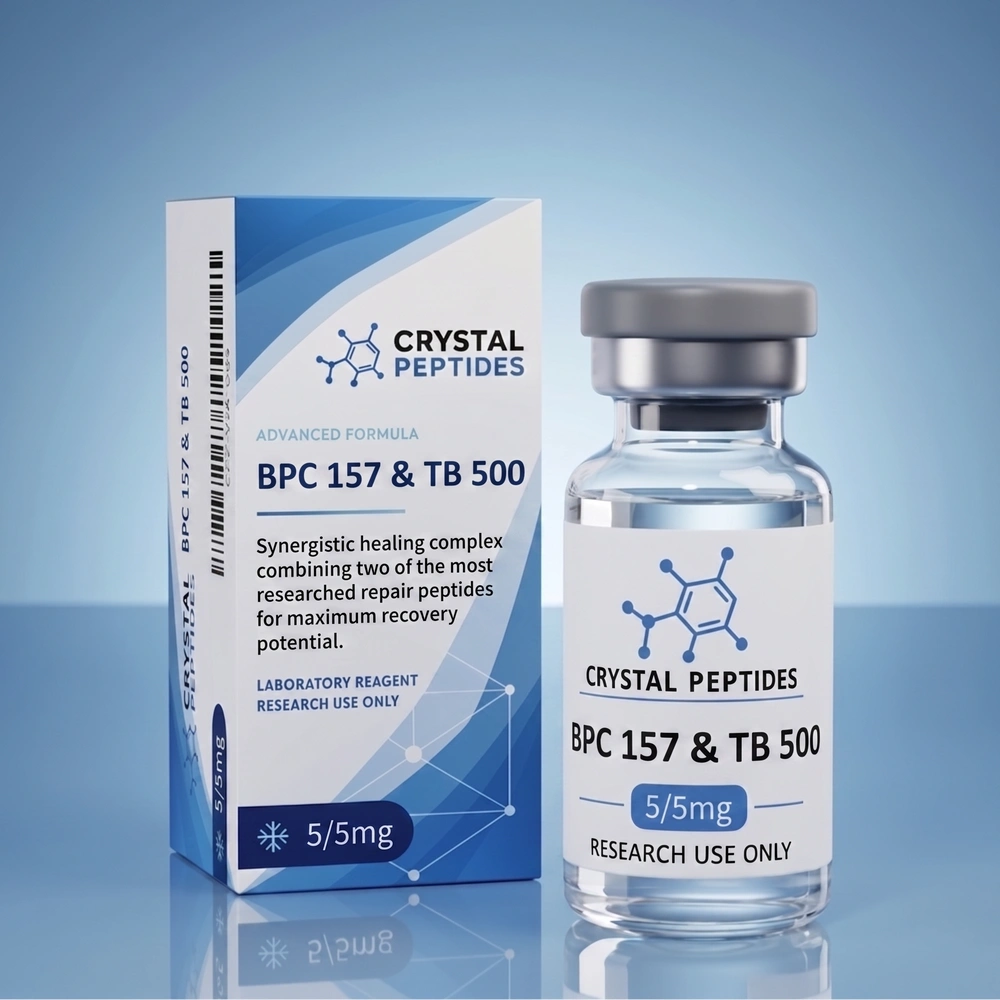
BPC 157 & TB 500 (5/5mg)
❄️Lyophilisiertes Pulver (nicht rekonstituiert)
Größe:
Gesamt: 59.96 CHF
Rabatt pro Menge
| Menge | Rabatt | Preis pro Einheit |
|---|---|---|
| 5 - 10 | 10% | 53.96 CHF |
| 11 - 20 | 15% | 50.96 CHF |
| 21+ | 20% | 47.97 CHF |
Strenge Tests durch unabhängige Labore
Jede Charge unserer Forschungschemikalien und Peptide wird von einem unabhängigen Labor auf Reinheit und Identität geprüft.
Gesamt: 59.96 CHF
BPC-157 & TB-500 ist eine Doppelpeptid-Forschungsformulierung, die zwei weithin untersuchte Forschungspeptide in einer einzigen Verbindung vereint. Manchmal als Wolverine Blend bezeichnet, enthält diese 5/5-mg-Formulierung von BPC-157 & TB-500 gleiche Mengen von BPC-157 und TB-500 und ermöglicht es Forschern, die komplementären biologischen Eigenschaften beider Peptide innerhalb desselben Versuchsmodells zu untersuchen.
Forscher in der gesamten Europäischen Union können BPC-157 & TB-500 kaufen bei Crystal Peptides als hochreine Forschungsformulierung, die von akkreditierten Drittlaboren auf Reinheit und Qualität geprüft wird. Analysenzertifikate werden vom Prüflabor bereitgestellt und sind auf der Produktseite verfügbar, damit Forscher Identität, Reinheit und Eignung des Peptids für die Forschung bestätigen können. Die BPC157 & TB-500-Mischung wird ausschließlich zu Forschungszwecken geliefert und ist weder von der Europäischen Arzneimittel-Agentur (EMA) noch von einer anderen wichtigen Arzneimittelbehörde als Arzneimittel zugelassen.
Warum die Kombination BPC-157 und TB-500 kaufen?
Obwohl sie häufig gemeinsam untersucht werden, sind BPC-157 und TB-500 strukturell nicht verwandte Peptide mit unterschiedlichen biologischen Eigenschaften. BPC-157 ist ein synthetisches Pentadecapeptid, das von einem natürlich vorkommenden Magenprotein-Fragment abgeleitet ist und auf seine Wechselwirkungen mit der Wachstumsfaktor-Signalübertragung, der Angiogenese, den Stickoxid-Signalwegen und der Biologie des Bindegewebes untersucht wurde.
Andererseits TB-500 ist ein synthetisches Peptid, das der biologisch aktiven Region von Thymosin beta-4 entspricht und in erster Linie hinsichtlich seiner Rolle bei der Aktin-Regulation, Zellmigration, zytoskelettalen Organisation und Gewebeumbildung untersucht wurde.
Da diese biologischen Signalwege eher komplementär als identisch sind, untersuchen Forscher beide Peptide häufig gemeinsam in Versuchsmodellen von muskuloskelettalem Gewebe, Bindegewebsbiologie, Wundheilung, vaskulärer Anpassung und weiter gefassten regenerativen Prozessen. Die Mischung wird als co-lyophilisiertes Laborreagenz geliefert, wobei jedes Peptid nach der Rekonstitution seine individuelle molekulare Identität und pharmakologischen Eigenschaften beibehält.
Chemische Eigenschaften und Registrierungsinformationen
Eigenschaften | BPC-157 | TB-500 |
Name und Synonyme | BPC-157, Body Protection Compound-157, PL 14736 | TB-500, Thymosin Beta-4 Fragment |
PubChem CID | 9941957 | 62707662 |
CAS-Nummer | 137525-51-0 | 885340-08-9 |
Molekülformel | C62H98N16O22 | C38H68N10O14 |
Molekulargewicht | 1419.5 g/mol | 4963.4 g/mol |
Peptidlänge | 15 Aminosäuren | 43 Aminosäuren |
Verbindungsklasse | Synthetisches Magen-Pentadecapeptid | Synthetisches Analogon von Thymosin beta-4 |
Primärer Forschungsschwerpunkt | Angiogenese, Bindegewebsbiologie, Stickoxid-Signalübertragung | Zellmigration, Aktin-Dynamik, zytoskelettale Organisation |
Mechanismus | In Untersuchung; mehrere Signalwege werden vorgeschlagen | Aktinbindendes Peptid, das an der zytoskelettalen Umbildung beteiligt ist |
Physikalische Form | Lyophilisiertes Pulver | Lyophilisiertes Pulver |
Löslichkeit | Bakteriostatisches oder steriles Wasser | Bakteriostatisches oder steriles Wasser |
Reinheit | Siehe COA | Siehe COA |
Geliefert als | Co-lyophilisierte Mischung | Co-lyophilisierte Mischung |
Die BPC-157 & TB-500-Mischung enthält zwei unabhängig charakterisierte Peptide, die in gleichen Anteilen in einem einzigen co-lyophilisierten Fläschchen geliefert werden. Jedes Peptid behält nach der Rekonstitution seine eigene molekulare Identität, physikochemischen Eigenschaften und vorgeschlagenen biologischen Mechanismen bei.
Obwohl sie aus Gründen der Zweckmäßigkeit gemeinsam geliefert werden, sollten BPC-157 und TB-500 als komplementäre Forschungsverbindungen und nicht als eine einzige molekulare Einheit betrachtet werden. Ihre individuellen Molekülformeln, Molekulargewichte und Registrierungsinformationen bleiben daher innerhalb der Mischung unverändert.
BPC-157: Forschungshintergrund und Daten
Jedes der Peptide in der BPC-157 & TB-500-Mischung wurde unabhängig charakterisiert und in verschiedenen Bereichen der regenerativen Biologie untersucht. Während die veröffentlichte Literatur BPC-157 hauptsächlich als eigenständige Forschungsverbindung bewertet hat, haben seine berichteten Auswirkungen auf die Bindegewebsphysiologie, Angiogenese und zelluläre Signalübertragung es zu einem der am meisten untersuchten regenerativen Peptide in der präklinischen Forschung gemacht.
Sehnenheilung, Fibroblastenmigration und Zellüberleben (Chang et al., 2011)
Anhand kultivierter Achillessehnen-Explantate von Ratten zeigten Chang und Kollegen, dass BPC-157 das Sehnenwachstum beschleunigte, die Fibroblastenmigration verbesserte und das Zellüberleben unter oxidativem Stress verbesserte. Das Peptid stimulierte die Fibroblastenproliferation nicht direkt, was darauf hindeutet, dass seine Wirkungen eher durch verbesserte Zellviabilität und -migration als durch erhöhte Zellteilung vermittelt wurden. Die Studie identifizierte zudem die Aktivierung des FAK-Paxillin-Signalwegs und lieferte damit mechanistische Einblicke, wie BPC-157 die Sehnenreparatur und die Regeneration des Bindegewebes beeinflussen könnte. [1]
Signalübertragung des Wachstumshormonrezeptors (Chang et al., 2014)
Eine nachfolgende Studie derselben Forschungsgruppe zeigte, dass BPC-157 die Expression des Wachstumshormonrezeptors (GHR) in Sehnenfibroblasten sowohl auf mRNA- als auch auf Proteinebene erhöhte. Durch die Erhöhung der GHR-Verfügbarkeit verstärkte die Vorbehandlung mit BPC-157 die durch Wachstumshormon induzierte Aktivierung des nachgeschalteten JAK2-Signalwegs und lieferte zusätzliche mechanistische Belege für die Rolle des Peptids in der Sehnenbiologie und Bindegewebsforschung. [2]
Muskuloskelettale Heilung und regenerative Forschung (McGuire et al., 2025)
Eine aktuelle narrative Übersichtsarbeit bewertete den wachsenden Bestand an präklinischer Forschung zu BPC-157 in Sehnen, Bändern, Muskeln, Knochen und Knorpel. Die Autoren kamen zu dem Schluss, dass die verfügbaren experimentellen Daten ein erhebliches regeneratives Potenzial in mehreren muskuloskelettalen Geweben zeigen, betonten jedoch, dass die Literatur überwiegend präklinisch bleibt und dass gut konzipierte klinische Studien am Menschen noch erforderlich sind, bevor klinische Schlussfolgerungen gezogen werden können. Die Übersichtsarbeit hebt BPC-157 als wichtiges Forschungsinstrument zur Untersuchung der regenerativen Biologie und der Bindegewebsphysiologie hervor, nicht als etabliertes therapeutisches Mittel. [3]
TB-500: Forschungshintergrund und Daten
TB-500 ist ein synthetisches Peptid, das der biologisch aktiven Region von Thymosin beta-4 (Tβ4) entspricht, einem natürlich vorkommenden Peptid, das an der Aktin-Regulation, Zellmigration und Gewebeumbildung beteiligt ist. Folglich stammt ein Großteil des wissenschaftlichen Verständnisses von TB-500 aus der umfangreichen Forschung zu Thymosin beta-4 und nicht aus Untersuchungen von TB-500 selbst.
Diese Studien haben die biologische Grundlage für die Untersuchung von TB-500 in der regenerativen Biologie, der Wundheilung und der Bindegewebsforschung geschaffen.
Wundheilung und Angiogenese (Malinda et al., 1999)
Eine der frühesten wegweisenden Studien zeigte, dass Thymosin beta-4 die Wundheilung in einem Vollhautwundmodell bei Ratten beschleunigte. Die Behandlung verbesserte die Reepithelisierung, erhöhte die Wundkontraktion, förderte die Kollagenablagerung, stimulierte die Angiogenese und erhöhte die Keratinozytenmigration signifikant. Diese Ergebnisse etablierten Thymosin beta-4 als wichtiges Forschungsmodell zur Untersuchung von Gewebereparatur, Gefäßbiologie und regenerativen Prozessen. [4]
Tierstudien zu Gewebereparatur und -regeneration (Philp et al., 2010)
Diese umfassende Übersichtsarbeit bewertete zahlreiche präklinische Studien zu Thymosin beta-4 in dermalen, kornealen, kardialen und anderen regenerativen Modellen. Insgesamt zeigten die überprüften Daten konsistente Rollen von Thymosin beta-4 bei Zellmigration, Angiogenese, zytoskelettaler Organisation, entzündlicher Regulation und Gewebeumbildung. Die Übersichtsarbeit hob zudem die Interaktion des Peptids mit G-Aktin als grundlegenden Mechanismus seiner biologischen Aktivität hervor und lieferte einen Großteil der wissenschaftlichen Grundlage für die nachfolgende Forschung zu TB-500 und verwandten Peptidanaloga. [5]
Die in diesem Abschnitt erörterten Beobachtungen dienen ausschließlich der Zusammenfassung der aktuellen wissenschaftlichen Literatur und sollten nicht als Beweis für klinische Wirksamkeit oder therapeutischen Nutzen ausgelegt werden. Die BPC-157 & TB-500-Mischung wird ausschließlich als Laborforschungsreagenz geliefert und ist nicht für den Einsatz am Menschen oder bei Tieren zugelassen.
Forschungsanwendungen
Die BPC-157 & TB-500-Mischung wird in der Laborforschung eingesetzt, um mehrere Aspekte der regenerativen Biologie und Gewebereparatur zu untersuchen. Da die konstituierenden Peptide unterschiedliche, aber komplementäre biologische Eigenschaften aufweisen, untersuchen Forscher sie häufig gemeinsam, um zu erforschen, wie unterschiedliche zelluläre Signalwege zur Heilung, Gewebeumbildung und strukturellen Wiederherstellung beitragen.
Diese Forschungsanwendungen basieren in erster Linie auf präklinischen Studien der einzelnen Peptide und nicht auf gezielten Untersuchungen der Kombination. Sie dienen ausschließlich der Beschreibung der aktuellen wissenschaftlichen Literatur und sollten nicht als Hinweis auf klinische Wirksamkeit, therapeutischen Nutzen oder eine zugelassene medizinische Anwendung ausgelegt werden.
Sehnen- und Bandbiologie
BPC-157 und TB-500 werden umfassend in Versuchsmodellen zur Reparatur von Sehnen und Bändern untersucht. Die Forschung hat ihren Einfluss auf die Fibroblastenaktivität, die Kollagenorganisation, die Umbildung der extrazellulären Matrix und die Wiederherstellung der Bindegewebsstruktur nach einer Verletzung untersucht. Die gemeinsame Untersuchung der Peptide ermöglicht es Forschern, mehrere biologische Prozesse zu untersuchen, die an der muskuloskelettalen Regeneration innerhalb eines einzigen Versuchsrahmens beteiligt sind.
Regeneration von Skelettmuskulatur und Weichgewebe
Experimentelle Studien haben die Rolle beider Peptide bei der Reparatur der Skelettmuskulatur, der Gewebeumbildung und der Erholung nach einer akuten Verletzung untersucht. Die BPC-157-Forschung konzentrierte sich in erster Linie auf die Wachstumsfaktor-Signalübertragung und die Gewebeintegrität, während TB-500 hinsichtlich seiner Rolle bei der zytoskelettalen Organisation und Zellmigration untersucht wurde. Zusammen tragen diese komplementären Forschungsbereiche zu einem umfassenderen Verständnis regenerativer Reaktionen im Muskelgewebe bei.
Angiogenese und Gefäßbiologie
Die Bildung neuer Blutgefäße ist ein wesentlicher Bestandteil der Gewebereparatur. BPC-157 wurde auf seine Wechselwirkungen mit angiogenen Signalwegen und der endothelialen Funktion untersucht, während die Forschung zu Thymosin beta-4, dem Ausgangspeptid, von dem TB-500 abgeleitet ist, wichtige Rollen bei der Migration von Endothelzellen und der Gefäßumbildung gezeigt hat. Diese komplementären Forschungsbereiche machen die Mischung wertvoll für die Untersuchung der vaskulären Anpassung während regenerativer Prozesse.
Zellmigration und Gewebeumbildung
Eines der Unterscheidungsmerkmale der TB-500-Forschung ist seine Beziehung zur Aktin-Dynamik und Zellbewegung. Im Gegensatz dazu wurde BPC-157 hinsichtlich seines Einflusses auf das Zellüberleben, die Gewebeorganisation und die Bindegewebshomöostase untersucht. Die gemeinsame Untersuchung dieser Peptide ermöglicht es Forschern zu untersuchen, wie koordinierte Zellmigration und strukturelle Umbildung zur Gewebergeneration beitragen.
Regenerative Biologie und Forschung zu kombinierten Peptiden
Die wichtigste wissenschaftliche Begründung für die Kombination von BPC-157 und TB-500 ist, dass beide Peptide unterschiedliche Aspekte der regenerativen Physiologie beeinflussen. Durch die Integration beider Peptide in eine einzige Forschungsformulierung können Forscher komplementäre Signalwege untersuchen, die an der Bindegewebsbiologie, vaskulären Anpassung, Organisation der extrazellulären Matrix und Zellreparatur beteiligt sind, während konsistente experimentelle Bedingungen aufrechterhalten werden.
Wie die BPC-157 & TB-500-Mischung wirkt (Wirkmechanismus)
Die BPC-157 & TB-500-Mischung kombiniert zwei Peptide, die über unterschiedliche molekulare Signalwege verschiedene Aspekte der Gewebebiologie beeinflussen. Obwohl beide umfassend in der regenerativen Forschung untersucht werden, sind sie strukturell nicht verwandt und teilen keinen gemeinsamen Wirkmechanismus.
Die wissenschaftliche Begründung für die Kombination von BPC-157 und TB-500 in dieser Mischung liegt in ihren komplementären Rollen in der Bindegewebsphysiologie, Zellmigration, Angiogenese und Gewebeumbildung.
Wirkmechanismus von BPC-157
Es wird angenommen, dass BPC-157 mehrere an der Gewebereparatur beteiligte Signalwege beeinflusst. Die experimentelle Forschung hat seine Wechselwirkungen mit der Stickoxid-Signalübertragung, dem vaskulären endothelialen Wachstumsfaktor (VEGF), der FAK-Paxillin-Signalübertragung und den mit dem Wachstumshormonrezeptor (GHR) verbundenen Signalwegen untersucht. Diese Mechanismen wurden in präklinischen Modellen mit Angiogenese, Fibroblastenmigration, Kollagenorganisation und Bindegewebshomöostase in Verbindung gebracht. Obwohl das genaue molekulare Ziel des Peptids noch nicht identifiziert wurde, deuten die verfügbaren Daten darauf hin, dass BPC-157 durch eine koordinierte Modulation mehrerer biologischer Signalwege wirkt, die an der Gewebereparatur beteiligt sind. [6]
Wirkmechanismus von TB-500
TB-500 ist ein synthetisches Peptid, das von der biologisch aktiven Region von Thymosin beta-4 abgeleitet ist. Ein Großteil seines vorgeschlagenen Mechanismus wird aus der umfangreichen Literatur zu Thymosin beta-4 abgeleitet, das globuläres Aktin (G-Aktin) bindet und sequestriert und so zur Regulierung der Aktin-Polymerisation, der zytoskelettalen Organisation und der Zellmigration beiträgt. Diese Prozesse sind grundlegend für die Gewebeentwicklung, Wundheilung, Angiogenese und die koordinierte Bewegung von Zellen während regenerativer Reaktionen. [7]
Die experimentelle Forschung hat Thymosin beta-4 zudem mit der Modulation der entzündlichen Signalübertragung, der Migration von Endothelzellen, der Umbildung der extrazellulären Matrix und der Aktivierung von an der Gewebergeneration beteiligten Signalwegen in Verbindung gebracht. Folglich haben sich Studien zu TB-500 auf seine potenzielle Rolle bei der Zellbewegung, Gewebeumbildung, Angiogenese und Wundheilung konzentriert, obwohl die genauen molekularen Mechanismen des synthetischen Peptids noch nicht vollständig charakterisiert sind. [8]
Kurz gesagt, die BPC-157-Forschung konzentriert sich hauptsächlich auf die Wachstumsfaktor-Signalübertragung, Stickoxid-Signalwege und die Bindegewebsphysiologie, während TB-500 hauptsächlich mit den strukturellen Prozessen verbunden ist, die es Zellen ermöglichen, zu wandern, ihr Zytoskelett zu reorganisieren und die Gewebeumbildung während der Regeneration zu koordinieren.
Komplementäre Wirkung von BPC-157 und TB-500
Die wissenschaftliche Begründung für die Kombination von BPC-157 und TB-500 basiert auf komplementärer Biologie und nicht auf überlappenden Mechanismen. Die Untersuchung beider Peptide innerhalb desselben Versuchssystems ermöglicht es Forschern zu untersuchen, wie diese unterschiedlichen biologischen Prozesse während der Gewebereparatur und regenerativer Reaktionen interagieren.
Dieser komplementäre Ansatz hat zur Popularität der Mischung in der Laborforschung beigetragen, wo Forscher mehrere Komponenten der Gewebergeneration innerhalb eines einzigen Versuchsrahmens untersuchen möchten.
BPC-157 & TB-500 im Vergleich zu verwandten Forschungsverbindungen
BPC-157 und TB-500 werden häufig gemeinsam untersucht, da sie unterschiedliche Aspekte der regenerativen Biologie beeinflussen. Während sich die BPC-157-Forschung hauptsächlich auf die Bindegewebsphysiologie und zelluläre Signalübertragung konzentrierte, konzentrierte sich die TB-500-Forschung auf die zytoskelettale Organisation und Zellmigration. Der folgende Vergleich zeigt, wie sich die Mischung von ihren konstituierenden Peptiden und einem weiteren umfassend untersuchten regenerativen Forschungspeptid unterscheidet.
BPC-157 & TB-500 Blend | ||||
Peptidklasse | Synthetisches Magen-Pentadecapeptid | Synthetisches Peptid, das der biologisch aktiven Region von Thymosin beta-4 entspricht | Natürlich vorkommendes kupferbindendes Tripeptid | Doppelpeptid-Forschungsformulierung |
Herkunft | Abgeleitet von einem natürlich vorkommenden Magenprotein-Fragment | Abgeleitet von der biologisch aktiven Region von Thymosin beta-4 | Natürlich vorkommendes menschliches kupferbindendes Peptid | Kombination aus BPC-157 und TB-500 in gleichen Anteilen |
Peptidlänge | 15 Aminosäuren | 43 Aminosäuren | 3 Aminosäuren | Peptide mit 15 bzw. 43 Aminosäuren |
Primärer biologischer Schwerpunkt | Bindegewebsbiologie, Angiogenese, Stickoxid-Signalübertragung | Zellmigration, zytoskelettale Organisation, Gewebeumbildung | Gewebeumbildung, Biologie der extrazellulären Matrix, Kollagensynthese | Untersuchung komplementärer regenerativer Signalwege |
Primärer Mechanismus | Mehrere Signalwege in Untersuchung | Mechanismus überwiegend aus der Biologie von Thymosin beta-4 abgeleitet; assoziiert mit G-Aktin-Regulation und Zellmigration | Modulation der Genexpression, des Kupfertransports und der Umbildung der extrazellulären Matrix | Kombiniert die unabhängigen biologischen Eigenschaften beider konstituierender Peptide |
Wichtigste Forschungsanwendungen | Biologie von Sehnen, Bändern, Muskeln, Magen-Darm-Trakt und Gefäßen | Gewebeumbildung, Wundheilung, Angiogenese und regenerative Biologie | Hautbiologie, Bindegewebsforschung, Wundheilung und regenerative Biologie | Integrierte Modelle der Bindegewebsreparatur und regenerativen Biologie |
Vergleich TB-500 vs. Thymosin beta-4
Obwohl die Namen innerhalb der Forschungsgemeinschaft oft synonym verwendet werden, sind TB-500 und Thymosin beta-4 nicht dieselbe Verbindung. Thymosin beta-4 (Tβ4) ist ein natürlich vorkommendes 43-Aminosäuren-Peptid, das in vielen Säugetiergeweben exprimiert wird und für einen Großteil der veröffentlichten Literatur verantwortlich ist, die die Aktin-Regulation, Zellmigration, Angiogenese und Gewebereparatur beschreibt. TB-500 hingegen ist ein synthetisches Peptid, das aus der biologisch aktiven Region von Thymosin beta-4 entwickelt wurde und viele der mit dem Ausgangspeptid verbundenen biologischen Eigenschaften in der experimentellen Forschung reproduzieren soll.
Diese Unterscheidung ist bei der Interpretation veröffentlichter Studien wichtig. Ein Großteil des mechanistischen Verständnisses, das üblicherweise TB-500 zugeschrieben wird, stammt aus Untersuchungen zu Thymosin beta-4 und nicht aus direkten Studien des synthetischen Peptids selbst. Folglich stützen sich Verweise auf TB-500 häufig auf den umfassenderen Bestand an Thymosin-beta-4-Forschung, um seine vorgeschlagene biologische Aktivität und wissenschaftliche Begründung zu erklären.
Qualität und Tests
Crystal Peptides verpflichtet sich, Forschungspeptide zu liefern, die hohe Standards an analytischer Qualität, Konsistenz und Rückverfolgbarkeit erfüllen. Jede Charge dieser BPC-157 & TB-500 5/5mg-Mischung durchläuft eine HPLC-Reinheitsanalyse und eine unabhängige Überprüfung durch akkreditierte Drittlabore, darunter Janoshik Analytical.
Die Tests können Peptididentität, Peptidgehalt, Sterilität, Endotoxine und Schwermetall-Screening umfassen, wobei für jede Charge Analysenzertifikate bereitgestellt werden, damit Forscher die analytischen Eigenschaften des genau gelieferten Materials überprüfen können.
Da diese Formulierung zwei unabhängig charakterisierte Peptide enthält, sollte die analytische Prüfung sowohl die Identität als auch die Qualität jedes konstituierenden Peptids überprüfen. Forscher sollten nach analytischen Daten suchen, die Folgendes umfassen:
- Chromatographische Reinheit mittels Hochleistungsflüssigkeitschromatographie (HPLC) zur Bewertung der Peptidreinheit und zur Erkennung potenzieller Verunreinigungen oder Abbauprodukte.
- Molekulare Identität, bestätigt durch Flüssigchromatographie-Massenspektrometrie (LC-MS) zur Überprüfung, dass sowohl BPC-157 als auch TB-500 ihren erwarteten Molekülmassen entsprechen und nicht substituiert oder falsch identifiziert wurden.
- Peptidgehalt und Zusammensetzung, zur Bestätigung, dass die Formulierung die erwarteten Mengen beider konstituierender Peptide enthält.
- Sterilitäts- und Endotoxintests, die dazu beitragen sicherzustellen, dass das Material für die Laborforschung geeignet ist, bei der mikrobiologische Kontamination die experimentellen Ergebnisse beeinträchtigen könnte.
- Schwermetall-Screening, das zusätzliche Sicherheit bietet, dass Rückstände aus der Synthese innerhalb der festgelegten Laborspezifikationen bleiben.
Die gemeinsame Betrachtung dieser analytischen Ergebnisse bietet deutlich mehr Vertrauen als das alleinige Vertrauen auf einen angegebenen Reinheitsprozentsatz und hilft Forschern, die Identität, Zusammensetzung und Gesamtqualität des Materials zu bestätigen, bevor es in die experimentelle Arbeit einbezogen wird.
Für die ordnungsgemäße Handhabung und Lagerung wird die BPC-157 & TB-500-Mischung als co-lyophilisiertes Pulver geliefert und sollte versiegelt, trocken, vor Licht geschützt und vorzugsweise bei -20 °C oder darunter gelagert werden, bis sie für die Forschung benötigt wird.
Rekonstituieren Sie mit bakteriostatischem oder sterilem Wasser. Anschließend sollte die Lösung bei 2–8 °C gekühlt, unter Anwendung geeigneter Labortechniken gehandhabt und gemäß den vom Labor festgelegten Stabilitätsprotokollen verwendet werden. Wiederholte Gefrier-Tau-Zyklen, längere Exposition gegenüber erhöhten Temperaturen und starkes Schütteln sollten vermieden werden, da diese Praktiken zum Abbau des Peptids beitragen und die Langzeitstabilität verringern können.
Regulatorisches und Rechtliches
Alle von Crystal Peptides gelieferten Produkte sind ausschließlich für Forschungs- und Entwicklungszwecke bestimmt. Sie werden ausschließlich als Laborforschungsreagenzien für die Verwendung durch qualifizierte Fachleute in kontrollierten wissenschaftlichen Umgebungen bereitgestellt und nicht für die Anwendung am Menschen oder bei Tieren geliefert.
Dieses Produkt ist kein Arzneimittel, Lebensmittel, Nahrungsergänzungsmittel, Medizinprodukt, Kosmetikum oder Tierarzneimittel. Die auf dieser Seite dargestellten Informationen dienen ausschließlich der Zusammenfassung der aktuellen wissenschaftlichen Literatur und sollten nicht als Beweis für klinische Wirksamkeit, therapeutischen Nutzen oder eine zugelassene medizinische Anwendung ausgelegt werden. Verweise auf veröffentlichte Studien beschreiben ausschließlich experimentelle Forschung und wurden weder von der Europäischen Arzneimittel-Agentur (EMA) noch von einer anderen Arzneimittelbehörde für die klinische Anwendung bewertet.
Die BPC-157 & TB-500-Mischung wurde als kombinierte Formulierung nicht in klinischen Studien bewertet und ist weder von der Europäischen Arzneimittel-Agentur (EMA) noch von der US-amerikanischen Food and Drug Administration (FDA) noch von einer anderen wichtigen Arzneimittelbehörde als Arzneimittel zugelassen. Die wissenschaftliche Begründung für diese Formulierung stammt in erster Linie aus veröffentlichten präklinischen Untersuchungen der einzelnen konstituierenden Peptide und nicht aus gezielten Studien der Kombination selbst. Crystal Peptides liefert diese Mischung ausschließlich für die Laborforschung und -entwicklung.
Forscher und Käufer sind dafür verantwortlich sicherzustellen, dass der Erwerb, die Einfuhr, Lagerung, Handhabung, Verwendung und Entsorgung von Forschungsmaterialien allen geltenden nationalen und lokalen Gesetzen und Vorschriften entsprechen. Da die Gesetzgebung zu Forschungschemikalien je nach Rechtsraum unterschiedlich ist, sollten Kunden die geltenden rechtlichen Anforderungen in ihrem eigenen Land überprüfen, bevor sie Laborreagenzien kaufen oder einführen.
Quellen und Referenzen
- Chang CH, Tsai WC, Lin MS, et al. The promoting effect of pentadecapeptide BPC 157 on tendon healing involves tendon outgrowth, cell survival, and cell migration. Journal of Applied Physiology. 2011;110(3):774-780.
- Chang CH, Tsai WC, Hsu YH, et al. Pentadecapeptide BPC 157 enhances the growth hormone receptor expression in tendon fibroblasts. Molecules. 2014;19(11):19066-19077.
- McGuire FP, Martinez R, Lenz A, et al. Regeneration or Risk? A Narrative Review of BPC-157 for Musculoskeletal Healing. Current Reviews in Musculoskeletal Medicine. 2025;18(12):611-619.
- Malinda KM, Sidhu GS, Mani H, et al. Thymosin beta 4 accelerates wound healing. Journal of Investigative Dermatology. 1999;113(3):364-368.
- Philp D, Kleinman HK. Animal studies with thymosin beta 4, a multifunctional tissue repair and regeneration peptide. Annals of the New York Academy of Sciences. 2010;1194:81-86.
- Yuan C, Demers A, Silva-Ortiz V, et al. From Regeneration to Analgesia: The Role of BPC-157 in Tissue Repair and Pain Management. International Journal of Molecular Sciences. 2026;27(6):2876.
- Xing Y, Ye Y, Zuo H, Li Y. Progress on the Function and Application of Thymosin β4. Frontiers in Endocrinology. 2021;12:767785.
- Su L, Kong X, Loo S, et al. Thymosin beta-4 improves endothelial function and reparative potency of diabetic endothelial cells differentiated from patient induced pluripotent stem cells. Stem Cell Research & Therapy. 2022;13(1):13.
Häufig gestellte Fragen
Was ist die BPC-157 & TB-500-Mischung?
Die BPC-157 & TB-500-Mischung ist eine Doppelpeptid-Forschungsformulierung, die gleiche Mengen von BPC-157 und TB-500 in einem einzigen co-lyophilisierten Fläschchen kombiniert. Die Formulierung ist in den Stärken 5/5 mg und 10/10 mg erhältlich und ermöglicht es Forschern, zwei komplementäre Peptidklassen innerhalb desselben Versuchsmodells zu untersuchen. Während BPC-157 hauptsächlich in Bezug auf Bindegewebsbiologie, Angiogenese und Wachstumsfaktor-Signalübertragung untersucht wurde, konzentrierte sich die TB-500-Forschung auf zytoskelettale Organisation, Zellmigration und Gewebeumbildung. Die Mischung wird ausschließlich für die Laborforschung geliefert und ist nicht für die Anwendung am Menschen oder bei Tieren zugelassen.
Ist die BPC-157 & TB-500-Mischung dasselbe wie der Wolverine Blend?
Ja. Wolverine Blend ist ein gebräuchlicher kommerzieller Spitzname auf dem Markt für Forschungspeptide für Formulierungen, die sowohl BPC-157 als auch TB-500 enthalten. Es handelt sich weder um ein eigenständiges Peptid noch um eine eigene molekulare Einheit, noch bezieht es sich auf eine standardisierte, von wissenschaftlichen oder regulatorischen Organisationen anerkannte Formulierung. Unabhängig vom verwendeten Namen sollten Forscher die Zusammensetzung, das Peptidverhältnis, die analytischen Tests und das mit jedem Produkt gelieferte Analysenzertifikat vor der Verwendung in der Laborforschung überprüfen.
Was ist der Unterschied zwischen TB-500 und Thymosin beta-4?
Obwohl die Begriffe oft synonym verwendet werden, sind TB-500 und Thymosin beta-4 (Tβ4) nicht identisch. Thymosin beta-4 ist ein natürlich vorkommendes 43-Aminosäuren-Peptid, das in vielen Säugetiergeweben exprimiert wird und für einen Großteil der veröffentlichten Literatur verantwortlich ist, die die Aktin-Regulation, Angiogenese, Zellmigration und Gewebereparatur beschreibt. TB-500 ist ein synthetisches Peptid, das aus der biologisch aktiven Region von Thymosin beta-4 entwickelt wurde und viele der mit dem Ausgangspeptid verbundenen biologischen Eigenschaften reproduzieren soll. Folglich stammt ein Großteil des mechanistischen Verständnisses von TB-500 aus Studien zu Thymosin beta-4 und nicht aus direkten Untersuchungen des synthetischen Peptids selbst.
Wurde die BPC-157 & TB-500-Mischung in klinischen Studien bewertet?
Derzeit gibt es keine veröffentlichten klinischen Studien, die speziell die BPC-157 & TB-500-Mischung als kombinierte Formulierung bewertet haben. Die wissenschaftliche Begründung für die Mischung stammt in erster Linie aus präklinischen Untersuchungen der einzelnen konstituierenden Peptide, die separat in Modellen der Bindegewebsbiologie, Angiogenese, Zellmigration und regenerativer Prozesse untersucht wurden. Folglich sollten die verfügbaren Daten nicht als Nachweis für klinische Wirksamkeit oder therapeutischen Nutzen der Kombination ausgelegt werden.
Stellt Crystal Peptides ein Analysenzertifikat (COA) bereit?
Ja. Jeder Charge liegt ein chargenspezifisches Analysenzertifikat (COA) bei, das direkt auf das unabhängige Prüflabor zurückgeführt werden kann. Das COA ermöglicht es Forschern, die Identität, Reinheit und analytischen Eigenschaften der genau gelieferten Charge zu überprüfen, bevor sie in die experimentelle Arbeit einbezogen wird. Crystal Peptides pflegt zudem eine spezielle Seite mit Labortests, auf der Forscher analytische Dokumentation einsehen und chargenspezifische Testergebnisse bestätigen können.
Wie wird die BPC-157 & TB-500-Mischung getestet?
Jede Charge des von Crystal Peptides verkauften BPC-157 & TB-500-Kombos durchläuft vor der Freigabe umfassende analytische Tests. Die Qualitätskontrolle umfasst eine HPLC-Reinheitsanalyse zur Bewertung der chromatographischen Reinheit und LC-MS zur Überprüfung der molekularen Identität von sowohl BPC-157 als auch TB-500. Je nach Charge können weitere Tests den Peptidgehalt, die Sterilität, Endotoxine und Schwermetall-Screening umfassen. Die unabhängige Überprüfung durch akkreditierte Drittlabore wie Janoshik Analytical gibt Forschern Vertrauen in die Identität, Reinheit und Gesamtqualität des gelieferten Materials.
Welche Fläschchengrößen der BPC-157 & TB-500-Mischung bietet Crystal Peptides an?
Crystal Peptides bietet derzeit die BPC-157 & TB-500-Mischung in co-lyophilisierten Forschungsfläschchen mit 5/5 mg und 10/10 mg an, wobei jede Formulierung gleiche Mengen beider konstituierender Peptide enthält. Die aktuelle Verfügbarkeit, Preise und chargenspezifische analytische Dokumentation sind auf der Produktseite angegeben, sodass Forscher die für ihre experimentellen Anforderungen am besten geeignete Formulierung auswählen können.
Wie sollte die BPC-157 & TB-500-Mischung rekonstituiert und gelagert werden?
Die BPC-157 & TB-500-Mischung wird als co-lyophilisiertes Pulver geliefert und wird üblicherweise im Labor unter Verwendung von bakteriostatischem oder sterilem Wasser rekonstituiert. Das Verdünnungsmittel sollte langsam an der Innenwand des Fläschchens eingebracht werden, um Schaumbildung zu minimieren, wonach sich das Peptid ohne starkes Schütteln natürlich auflösen sollte. Nach der Rekonstitution sollte die Lösung bei 2–8 °C gekühlt und mit geeigneten Laborverfahren gehandhabt werden. Nicht rekonstituierte Fläschchen sollten versiegelt, trocken, vor Licht geschützt und vorzugsweise bei -20 °C oder darunter gelagert werden. Wiederholte Gefrier-Tau-Zyklen und längere Exposition gegenüber erhöhten Temperaturen sollten vermieden werden, um die Integrität des Peptids zu erhalten.
Wo kann ich BPC-157 & TB-500 für Forschungszwecke kaufen?
Forscher in der gesamten Europäischen Union können die BPC-157 & TB-500-Mischung kaufen bei Crystal Peptides als hochreine Forschungsformulierung, die ausschließlich für die Laborforschung geliefert wird. Das Unternehmen setzt sich für analytische Transparenz, rückverfolgbare Qualitätsdokumentation und zuverlässige Auftragsabwicklung ein und ist damit eine vertrauenswürdige Quelle für Forschungspeptide für Universitäten, Labore und unabhängige Forscher in ganz Europa.
Versendet Crystal Peptides die BPC-157 & TB-500-Mischung in ganz Europa?
Ja. Crystal Peptides versendet die BPC-157 & TB-500-Mischung in ganz Europa mit diskreter Verpackung und nachverfolgbaren Versanddiensten. Bestellungen werden in der Regel umgehend versandt, wobei die Lieferzeiten je nach Zielland variieren, und Expressversand ist für viele europäische Ziele verfügbar. Forscher können Versandoptionen, geschätzte Lieferzeiten, akzeptierte Zahlungsmethoden und länderspezifische Bestellinformationen einsehen, bevor sie eine Bestellung aufgeben.