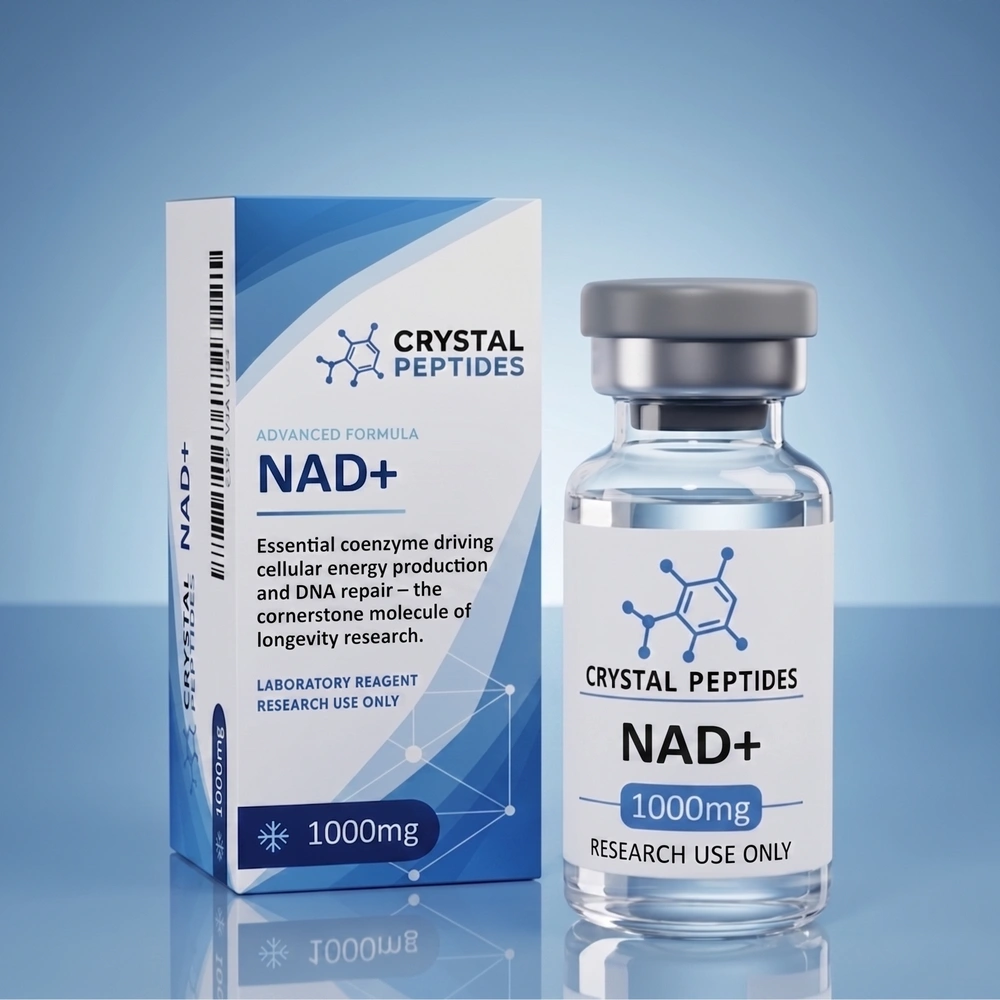
NAD+
1000mg
❄️Lyophilisiertes Pulver (nicht rekonstituiert)
Gesamt: 82.57 CHF
Rabatt pro Menge
| Menge | Rabatt | Preis pro Einheit |
|---|---|---|
| 5 - 10 | 10% | 74.32 CHF |
| 11 - 20 | 15% | 70.19 CHF |
| 21+ | 20% | 66.06 CHF |
Strenge Tests durch unabhängige Labore
Jede Charge unserer Forschungschemikalien und Peptide wird von einem unabhängigen Labor auf Reinheit und Identität geprüft.
Gesamt: 82.57 CHF
NAD+ wird als katalogisiertes Forschungsmaterial in einer Menge von 1000 mg geliefert.
NAD+ ist ein oxidiertes Dinukleotid-Coenzym und kein Peptid. Öffentliche Datensätze zu Formel und Masse unterscheiden sich je nach Protonierung; gelieferte Materialien können zudem Salze oder Hydrate sein. Für die Auswahl der Kennungen ist daher die konkrete Chargenform maßgeblich [1,2].
Chemische Eigenschaften und Registrierungsangaben
| Eigenschaft | Wert |
|---|---|
| Name und Synonyme | NAD+; oxidiertes β-NAD+; β-Nicotinamidadenindinukleotid, oxidierte Form; Nadid |
| Materialkategorie | Oxidiertes Dinukleotid-Coenzym; biochemisches Forschungsmaterial; kein Peptid |
| Sequenz oder Strukturdefinition | Kein Peptid. Oxidiertes β-Nicotinamidadenindinukleotid aus Adenin-Ribose- und Nicotinamid-Ribose-Nukleotideinheiten, die über Pyrophosphat verbunden sind. |
| Summenformel | Protonierungsabhängige Datensätze: C21H28N7O14P2+ für CID 5893; C21H27N7O14P2 für CID 925. Salze und Hydrate weichen ab. |
| Durchschnittliche Molekülmasse | Protonierungsabhängig: ungefähr 664.43 g/mol für CID 5893 und 663.43 g/mol für CID 925; Salze und Hydrate besitzen andere Massen. |
| CAS-Registrierungsnummer | 53-84-9 für β-NAD+, vorbehaltlich der Bestätigung von konkretem Oxidations- und Protonierungszustand, Salz und Hydratationszustand. |
| PubChem-CID | Protonierungsabhängige Datensätze umfassen CID 5893 für NAD(+) und CID 925 für eine anders protonierte NAD-Struktur; erst nach Bestätigung der konkreten Form auswählen. |
| Strukturelle Merkmale | Oxidierter Nicotinamid-Redoxzustand; Phosphatprotonierung, Gegenionen und Hydratation definieren das konkrete isolierte Material. |
| Physische Form | Katalogfläschchen; der genaue Aggregatzustand, das Salz beziehungsweise Gegenion und die Hilfsstoffe sind chargenspezifisch und müssen im CoA und SDS überprüft werden. |
| Kataloggrößen | 1000 mg |
| Chargenidentität und Qualitätsdokumentation | Die chargenspezifische Identität und die verfügbaren Analyseberichte müssen mit dem CoA-Eintrag abgeglichen werden, der der genauen Produktgröße und Charge zugeordnet ist. |
Registrierungswerte gelten ausschließlich für die übereinstimmende Sequenz oder Struktur und die konkrete Materialform. Endmodifikationen, Konjugation, Salz beziehungsweise Gegenion und Hydratation sind anhand des chargenspezifischen CoA und SDS zu bestätigen; Chargenunterlagen haben Vorrang vor Literaturkennungen.
Forschungshintergrund und veröffentlichte Evidenz
Veröffentlichte Forschung
NAD+ wird als Cofaktor oder Analyt in Enzym-, Redox-, Sirtuin- und ADP-Ribosylierungsassays sowie in analytischen Studien zum Nicotinamid-Nukleotidstoffwechsel eingesetzt [2,3].
Aktueller wissenschaftlicher Kenntnisstand
Biochemische Cofaktorfunktion und extrazelluläre Bereitstellung belegen für sich genommen weder die Zellaufnahme noch die Wiederherstellung intrazellulärer NAD+-Pools. Die Assayliteratur belegt weder Sicherheit und Wirksamkeit beim Menschen noch die Leistung dieser Katalogcharge.
NAD+, NADH, Datensätze für freie Säure/Protonierung sowie Natrium- oder andere Salze sind analytisch verschieden und dürfen keine uneingeschränkten Massen oder Kennungen gemeinsam verwenden.
Technischer Vergleich
| Aspekt | Dieses Katalogmaterial | Vergleichsmaterial |
|---|---|---|
| Identität | Katalogmaterial aus oxidiertem NAD+, wobei konkrete Protonierungs- und Salzform durch die Charge zu bestätigen sind | Reduziertes Nicotinamidadenindinukleotid, NADH |
| Struktureller Unterschied | Oxidierter Nicotinamid-Redoxzustand | Reduzierter Nicotinamid-Redoxzustand mit eigenständiger Zusammensetzung und spektraler Antwort |
| Analytische Bedeutung | Oxidationszustand, Protonierung, Gegenion, Hydratation und Analytgehalt bestätigen | NADH-spezifische Masse und Absorptionseigenschaften müssen getrennt gemessen werden |
Qualität und Prüfung
Qualitätsangaben sind chargen- und größenbezogen. Verwenden Sie ausschließlich den Bericht, der mit der konkreten Größe und Charge verknüpft ist. Ein für eine andere Größe, Charge oder ein ähnlich bezeichnetes Material aufgeführter Bericht darf nicht als Nachweis für dieses Produkt herangezogen werden.
Chromatografische Flächenreinheit, Identität, Nettopeptid- beziehungsweise Analytgehalt, Wasser- oder Gegenionengehalt, Sterilität, Endotoxine und elementare Verunreinigungen sind unterschiedliche Messgrößen. Ein Ergebnis belegt nicht automatisch die übrigen. Als verfügbar gelten nur Prüfungen, die durch einen einsehbaren, übereinstimmenden Bericht belegt sind.
Handhabung und Lagerung im Labor
Nur unter den auf Produktetikett, chargenspezifischem CoA und SDS angegebenen Bedingungen lagern und handhaben. Den Behälter gesichert, korrekt gekennzeichnet und vor Kontamination geschützt aufbewahren. Lagerung, Lösungsmittelverträglichkeit oder Stabilität dürfen nicht von einer verwandten Verbindung abgeleitet werden.
Laborvorbereitung, Auswahl der Analysemethode, Risikobeurteilung, persönliche Schutzausrüstung und Abfallentsorgung sollten dem geltenden SDS und den genehmigten Verfahren der Institution entsprechen.
Rechtlicher und regulatorischer Status
| Hinweis zur Verwendung in der Forschung | Dieses Material wird ausschließlich für die Laborforschung durch qualifizierte Fachkräfte geliefert und ist nicht zur Anwendung bei Menschen oder Tieren bestimmt. Käufer sind für die Einhaltung der geltenden örtlichen Anforderungen verantwortlich. |
Quellen und Literatur
- [1] PubChem. NAD(+), CID 5893.
- [2] KEGG Compound C00003. NAD+.
- [3] Imai et al. Sir2 as an NAD-dependent deacetylase linking metabolism and transcription. Nature (2000).
Häufig gestellte Fragen
Gelten die CAS-Nummer und die PubChem-CID für jede Chargenform?
Nur wenn die konkrete Sequenz oder Struktur, die Endgruppen, Konjugation, das Salz beziehungsweise Gegenion und der Hydratationszustand übereinstimmen. Maßgeblich sind das chargenspezifische CoA und SDS; die Kennung einer verwandten Verbindung darf nicht ersatzweise verwendet werden.
Was bedeutet ein analytisches Reinheitsergebnis?
Es ist methoden- und berichtsspezifisch. Beispielsweise ist ein HPLC-Flächenanteil nicht automatisch gleichbedeutend mit Identität, Nettogehalt, Sterilität, Endotoxinstatus oder der Abwesenheit elementarer Verunreinigungen.
Wie ist das Material zu lagern und zu handhaben?
Befolgen Sie das konkrete Etikett, das chargenspezifische CoA und SDS sowie die Risikobeurteilung der Institution. Verwenden Sie ausschließlich Lagerungs- und Stabilitätsangaben, die mit der konkreten Materialform und Charge verknüpft sind.